
Published
defining lending panelsDefining lending panels for property finance
By James Dawes, CeMAP, Founder, James William & Co Capital

A lending panel is the curated list of banks, challenger lenders, specialist bridging and development funders, private credit funds and family office channels that a broker or intermediary can actually access to arrange finance on a client’s behalf. For professional developers and high-net-worth borrowers, the panel behind your adviser is often more important than the adviser’s job title. A well-built panel raises approval rates, speeds up credit decisions and, critically, unlocks off-market pricing that never reaches the open market.
This matters because lenders themselves treat panels as a filtering mechanism. According to the British Business Bank, brokers act as a quality control layer, pre-screening applications so only deals that fit a lender’s actual risk appetite get submitted. That single fact explains why two borrowers with near-identical deals can get wildly different outcomes depending on who is brokering them. James William & Co Capital works this way deliberately, building relationships with family offices, private credit funds and specialist lenders that most retail brokers never touch, and the FCA’s mortgage market study has documented how panels shift as lenders are added or dropped based on service performance and appetite.
Key takeaways
Usable lender access, not headline panel size, determines whether a complex property deal gets funded quickly and on favourable terms.
| Point | Details |
|---|---|
| Definition | A lending panel is a broker’s curated network of banks, specialist lenders and private credit providers, not a static directory. |
| Usable access over size | Test named underwriter contacts and escalation routes rather than trusting a headline lender count. |
| Panels change | Lenders get added or removed based on service and appetite, so review your broker’s panel periodically, not just once. |
| Preparation speeds decisions | A complete data pack (title, cashflow model, exit strategy) shortens time to credit committee. |
| Capital-concierge advantage | James William & Co Capital’s single point of contact converts panel relationships into faster, bespoke execution for complex deals. |
Table of Contents
- Lending panel definition: what it is and how it works
- Why lending panel access matters for developers and HNW borrowers
- How brokers curate and review their lender panels
- Panel size vs usable access: the metric that actually matters
- How lending panels shape deal structuring and pricing
- Risks and limitations of relying on lending panels
- Practical checklist before instructing a broker
- How a capital-concierge model turns panel access into execution
- Why usable access beats panel size, every time
- Get specialist lender access through James William & Co Capital
- Primary sources and further reading
- Sources
- FAQ
Lending panel definition: what it is and how it works
A lending panel is not a static list gathering dust in a compliance folder. It is a living network of relationships, some formal and accredited, others informal and referral-based, that determines which lenders a broker can genuinely put a deal in front of.
Panels typically contain a mix of:
- High-street and challenger banks — useful for straightforward commercial mortgages and standard buy-to-let, less flexible on complex structures.
- Specialist bridging lenders — funders built for speed, often completing in days rather than weeks, but pricing reflects that urgency.
- Development finance lenders — providers who understand drawdown schedules, build costs and exit strategies for ground-up projects.
- Private credit funds — institutional capital that can write large, bespoke facilities outside standard lending criteria.
- Mezzanine providers — lenders who plug the gap between senior debt and equity, often the difference between a deal proceeding or stalling.
- Family office channels — patient, relationship-driven capital that rarely advertises and is almost never accessible without an existing introduction.
Access to these lenders comes in three forms: direct accreditation (the broker is formally registered and can submit straight to underwriting), referral routes (a warm introduction through an existing relationship), and sourcing-system visibility (the lender appears on a technology platform but responsiveness still needs testing). The sourcing system effect research makes a sharp point here: visibility on a system is not the same as usable access. A lender can sit on a sourcing platform and still take three weeks to answer an email.
The operational flow a broker follows is fairly consistent: an initial brief captures the deal’s shape, the broker packages and pre-screens the application, then routes it to the lender (or lenders) with the closest appetite fit, sometimes escalating to a senior underwriter for complex cases, before formal submission and credit committee review. Done properly, this whole process filters out weak matches before a lender ever sees the file, which is exactly the quality control function the British Business Bank describes.
Why lending panel access matters for developers and HNW borrowers
Speed and approval probability are the two things every experienced developer cares about, and both hinge on the quality of the panel behind your broker.
- Pre-screened, well-packaged applications routinely secure faster credit decisions because underwriters trust the broker’s diligence and spend less time re-verifying basics.
- Panels with genuine product depth (development, bridging, mezzanine) mean a complex credit profile gets matched to a lender with the actual appetite and operational capacity to fund it, rather than being forced through a generalist that half-fits.
- Timing on development exits, bridge-to-refinance transitions and rapid acquisitions often depends on which lenders a broker can reach directly, not which lenders technically exist in the market.
- Diverse panel access creates genuine competitive tension between lenders, which tends to sharpen pricing and terms rather than leaving a borrower stuck with a single quote.
- Developers in particular often work with a small number of trusted intermediaries because new-build and development lending is more concentrated than the wider mortgage market, and some lenders set contractual KPIs with brokers to guarantee fast turnaround on referred deals.
How brokers curate and review their lender panels
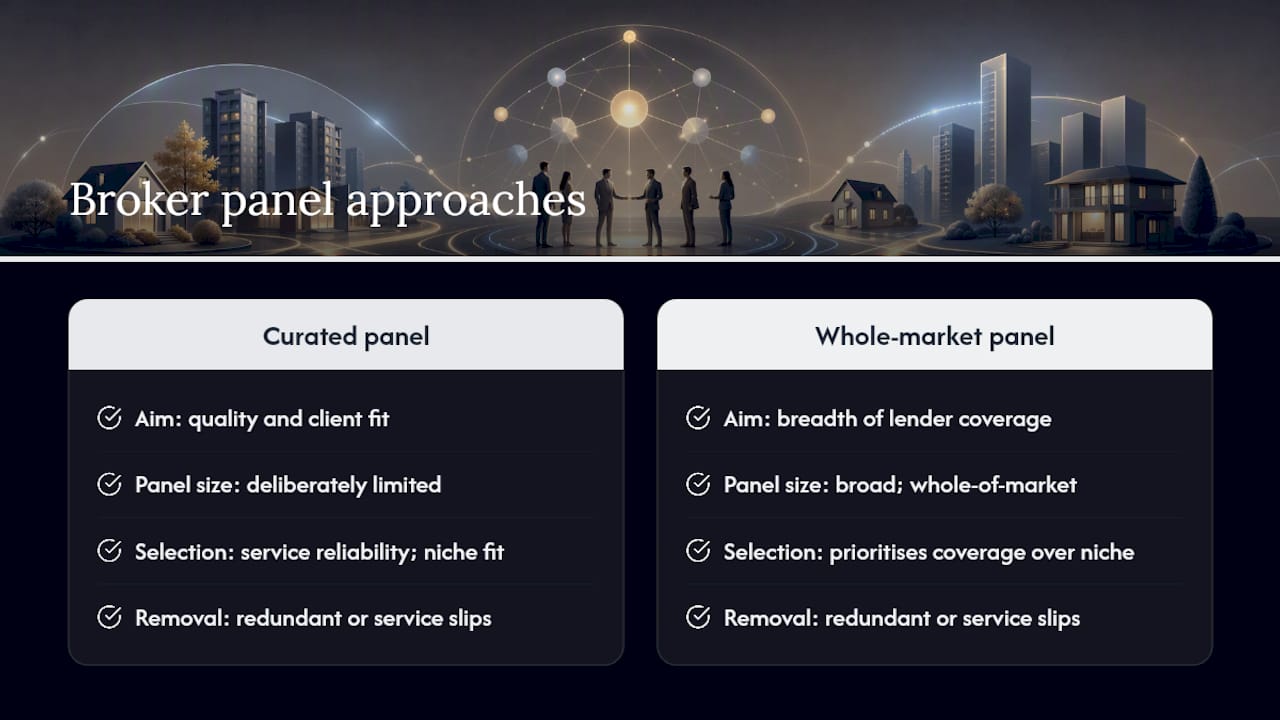
Building a panel is not a one-off exercise. Intermediaries add and remove lenders continuously based on service reliability, how well a lender’s product niche fits their client base, and whether the lender’s support during underwriting actually holds up under pressure.
The FCA’s own market study on mortgage panels found that firms take genuinely different approaches: some run deliberately limited, curated panels focused on quality, while others chase whole-of-market coverage for breadth. Crucially, the same study notes that lenders get removed from panels when their proposition becomes redundant or their service levels slip, often following a formal review rather than a single bad experience. That is worth knowing if you are relying on a broker’s panel composition today, because it may look different in twelve months.
Sourcing systems and technology platforms like those built by Loanofficer have expanded how many lenders a broker can theoretically see, but a genuinely rigorous broker still tests whether stated lending criteria hold up in practice, and whether a named underwriter will actually pick up the phone.
Pro Tip: Ask any broker how often they formally review their panel and what triggered the last lender removal. A vague answer usually means the panel is reviewed reactively, not proactively.
Panel size vs usable access: the metric that actually matters
A broker boasting about “200 lenders on our panel” is telling you almost nothing useful. What matters is usable access: named underwriter contacts, genuine escalation routes, and whether the lender will negotiate bespoke pricing rather than just quote from a rate card.
The Connect Brokers checklist for advisers puts this well: the right questions are which lenders are actually available for your specific case, whether access is direct or referral-based, and whether specialist support and escalation exist when a deal gets complicated. Vanity panel size skips all three.
| Access dimension | Vanity panel size | Usable access |
|---|---|---|
| Lender count | Headline number, rarely verified | Small, tested subset that reliably delivers |
| Contact route | Generic email or online portal | Named underwriter or credit contact |
| Escalation | None, or unclear | Defined route to senior decision makers |
| Pricing flexibility | Standard rate card only | Bespoke terms negotiated case by case |
| Reliability | Untested, may be dormant | Recently placed similar deals |
Before instructing a broker, ask directly: which of these lenders have you placed a deal with in the last six months, who is your named contact there, and what happens if that lender says no?
How lending panels shape deal structuring and pricing
The route a deal takes through a panel changes the outcome, not just the speed. Consider three anonymised scenarios that come up constantly in specialist property finance.
A development exit needing a quick bridge to repay a construction facility benefits from a lender who understands drawdown history and won’t re-underwrite the whole scheme from scratch. A short-term bridge rolling into a term refinance needs a lender comfortable with a defined exit rather than one insisting on immediate repayment certainty. A mezzanine top-up to close a funding gap needs a provider who will sit behind senior debt without demanding covenants that make the senior lender uncomfortable. Each of these routes through a different part of the panel, and each changes the covenant package and pricing on offer.
| Deal type | Typical panel route | Key data pack items | Structuring impact |
|---|---|---|---|
| Development exit bridge | Specialist bridging lender | Build cost report, drawdown schedule, exit valuation | Faster completion, pricing tied to exit certainty |
| Bridge to refinance | Bridging then term lender | Rental projections, refinance terms, planning status | Structure allows staged rate reduction |
| Mezzanine top-up | Private credit fund or mezzanine provider | Senior facility agreement, cashflow model, security schedule | Covenant negotiation between senior and junior debt |

Lenders reserve their most flexible underwriting and bespoke pricing for brokers who consistently deliver clean, well-packaged files, according to the British Business Bank. That priority access is earned over repeated deals, not bought with a single introduction. Access to family offices and private credit funds in particular can materially change a covenant profile, since this capital is often more patient and less rigid than standard institutional debt.
Risks and limitations of relying on lending panels
Panels are not a guarantee, and treating them as one is a mistake worth avoiding. The main risks are panel composition changing after you have already onboarded with a broker, the difference between referral access and direct accreditation quietly narrowing your options, potential conflicts of interest where an adviser favours a lender paying higher commission, and operational bottlenecks when a “usable” lender turns out to be slow in practice.
The FCA’s market study on mortgage panels is the clearest regulatory signal here: it confirms that firms genuinely differ in whether they run curated or whole-of-market panels, and that lenders get dropped from panels when service or proposition quality declines. That is not a hypothetical risk. It is an observed, ongoing feature of how intermediary panels behave, which means the panel your broker had last year may not be the panel they have today.
A one-off review of your broker’s panel at the start of a relationship is not enough. Ask how frequently it gets reassessed, and build that into your own diligence when relying on a broker for a complex, time-sensitive transaction.
Practical checklist before instructing a broker
Preparation shortens the distance between your first conversation and a credit committee decision. Before you instruct anyone, get these ready:
- Title and planning status — current land registry title and, for development deals, up-to-date planning permission documentation.
- Project team CVs — contractor, architect and project manager credentials, since lenders assess execution risk as much as the numbers.
- Cashflow model — a projected drawdown and repayment schedule that matches the facility being requested.
- Exit strategy — a clearly defined route to repayment, whether sale, refinance or income stabilisation.
- Security schedule — full detail of the assets being offered and any existing charges against them.
Then interrogate the broker directly: who are your named underwriter contacts for this lender type, what similar cases have you placed in the last six months, what’s your escalation route if the first lender declines, how often is your panel formally reviewed, and what is a realistic turnaround time for this specific deal? Answers that are vague or generic are a warning sign. Specific answers, with names and timeframes, indicate genuine usable access rather than a directory listing.
How a capital-concierge model turns panel access into execution
A capital-concierge approach means one person owns the entire process: packaging the deal, making named introductions, negotiating bespoke terms, and staying on top of execution until completion. That single point of contact matters more than it sounds, because complex property deals fail almost as often from poor coordination between parties as from weak fundamentals.
A development client needed a bridge-to-refinance solution inside four weeks to avoid breaching a construction facility deadline. Direct approaches to two high-street lenders had already stalled over documentation queries. Routeing the same deal through a private credit contact with a named underwriter and a pre-agreed escalation path cut the assessment time roughly in half and secured terms that were never advertised.
That is the practical value of the model: reduced time to offer, covenant structures negotiated rather than accepted as standard, and access to private credit and family office capital that a generalist broker would never reach. It converts panel access from a theoretical list into an actual result on a specific deadline.
Why usable access beats panel size, every time
Most guidance on choosing a broker focuses on the wrong metric. Panel size is easy to advertise and easy to misunderstand, so it gets repeated constantly, while usable access, the thing that actually determines whether your deal gets funded on time, gets almost no attention.
The uncomfortable truth is that a broker with fifteen lenders they know intimately will outperform one with two hundred lenders they have never actually tested. I’d go further: a large panel can be a red flag rather than a reassurance, because it often signals breadth chased for marketing purposes rather than depth built through repeat delivery. The FCA’s own market study backs this up implicitly, describing lender removals and formal reviews as an ongoing, deliberate process, not a sign of instability. Panels that never change are the ones worth questioning.
For a developer or HNW borrower with a genuinely complex deal, the right question is never “how many lenders do you have?” It is “how many of these lenders have you placed a deal with recently, and can you name the person who will pick up the phone?”
Get specialist lender access through James William & Co Capital
James William & Co Capital exists precisely because panel size means nothing without the relationships to back it. The firm structures bridging finance, development finance, commercial mortgages, mezzanine debt, asset finance and JV equity, working directly with family offices, private credit funds and specialist lenders that most brokers only see on a sourcing system, never in practice.
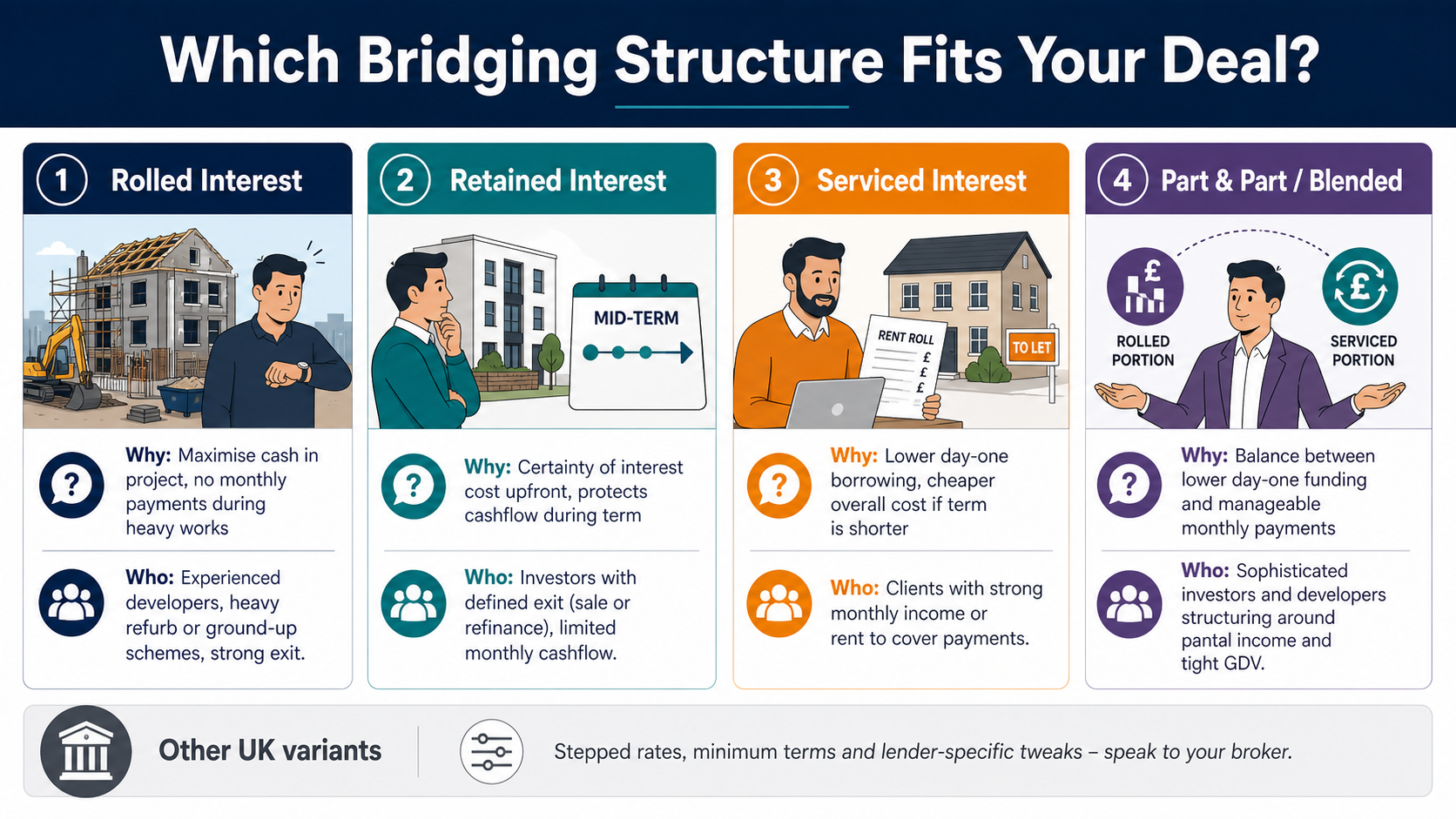
That is the practical difference of the capital-concierge model: one point of contact who packages your deal, makes the named introduction, and negotiates terms rather than accepting a rate card. On a recent bridge-to-refinance case, moving from a stalled direct approach to a warm introduction inside the specialist property finance network cut assessment time significantly and secured pricing that was never advertised publicly. If you have a complex development, bridging or mezzanine requirement and want to know exactly which lenders can genuinely fund it, get in touch with James William & Co Capital to arrange a confidential briefing.
Primary sources and further reading
- British Business Bank: what is a commercial finance broker — explains how brokers pre-screen deals and why lenders value panel filtering.
- FCA mortgages market study, interim report annex 7 — regulatory findings on panel review, lender removal and developer lending concentration.
- Connect Brokers: mortgage network comparison checklist — practical questions for testing genuine lender access.
- Mortgage Soup: the sourcing system effect in specialist lending — why sourcing-system visibility isn’t the same as usable access.
James William & Co Capital’s case studies and service pages provide further detail on how these principles apply to real transactions.
This article is general information, not a substitute for advice from a qualified financial advisor. Consult a qualified financial professional about your own circumstances before acting on anything here.
Sources
- What is a commercial finance broker — British Business Bank
- MS16/2.2: Mortgages market study: interim report: annex 7 — FCA
- Mortgage network comparison checklist for UK advisers — Connect Brokers
- The sourcing system effect in specialist lending — Mortgage Soup
FAQ
What is a lending panel in property finance?
A lending panel is the curated list of banks, specialist lenders, private credit funds and family office channels that a broker can access to arrange bridging, development, commercial and bespoke debt solutions.
How do lending panels improve approval rates?
Brokers pre-screen and package applications so only deals matching a lender’s actual risk appetite get submitted, which the British Business Bank confirms speeds up credit decisions and improves approval rates.
Does a larger lending panel mean better access?
No. Panel size is a poor proxy for usable access; what matters is whether lenders are genuinely reachable through named contacts and clear escalation routes, not how many names appear on a list.
How often should a broker review their lending panel?
Panels should be reviewed regularly, since lenders get added or removed based on service reliability and appetite shifts, a pattern documented in the FCA’s mortgage market study.
How does James William & Co Capital use its lending panel?
James William & Co Capital operates a capital-concierge model, using named relationships with family offices, private credit funds and specialist lenders to negotiate bespoke terms rather than relying on standard rate cards.
Recommended
Related Topics
Speak to a specialist
Discuss your finance with James directly
Whole-of-market specialist finance — bridging, development, commercial and residential. No call centres, no obligation. James reviews every enquiry personally.
New to specialist finance? How unbiased broker advice works · Deals we have completed
Explore Related Finance