
Published · Updated
student accommodation financeFinancing a UK student accommodation scheme: what lenders back in 2026
By James Dawes, CeMAP, Founder, James William & Co Capital

The most reliable route to financing UK purpose-built student accommodation is a bespoke, multi-layered structure: senior development or investment debt, mezzanine or JV equity, and short-term bridging where a gap needs covering, all arranged as one package by a specialist capital-concierge rather than sourced piecemeal from a single bank. Three things decide the terms you get quoted. First, your income model, since nomination agreements price more keenly and support higher leverage than direct-let schemes, which carry annual re-letting risk. Second, the scheme’s stage, because a raw site, a building in lease-up and a stabilised asset are three different underwriting exercises. Third, your (or your operator’s) track record.
- Build a lender-grade financial model with GBP cashflows before you approach anyone.
- Confirm your operator or nomination arrangements early, since they anchor the income case.
- Decide your target leverage profile, then mandate a structuring partner to run lenders against each other.
Pro Tip: Get your model and planning position in order before the first lender call. A scheme that arrives underprepared gets slower terms and worse pricing, even when the fundamentals are sound.
Key Takeaways
Structured PBSA finance works best as a multi-layered stack, priced and staged by a capital-concierge who underwrites development, lease-up and stabilisation as distinct risks.
| Point | Details |
|---|---|
| Match structure to stage | Development, lease-up and stabilised assets need different leverage and covenant packages from lenders. |
| Nomination income improves terms | Institutional nomination agreements typically price more keenly than direct-let schemes carrying annual re-letting risk. |
| Prepare a full documentation pack | Financial models, planning status, GBP cashflows and sponsor track record all need to be lender-ready before approach. |
| Plan the refinance early | Start refinancing to long-term debt three to six months before practical completion to avoid a maturity cliff-edge. |
| Appoint a structuring partner | James William & Co Capital runs senior debt, mezzanine and JV equity as one coordinated capital-concierge process. |
Table of Contents
- Typical timeline to commit and draw on student accommodation finance
- What documentation do lenders expect for PBSA finance?
- How should you structure exits and refinances for PBSA schemes?
- How do you find and appoint a structuring partner for PBSA finance?
- Case studies: how PBSA capital stacks actually come together
- How James William & Co Capital structures PBSA capital stacks
- Sources
- FAQ
Typical timeline to commit and draw on student accommodation finance
Most sponsors underestimate how long the process from first conversation to first drawdown actually takes, largely because they think of it as one transaction rather than three.
Initial due diligence, covering your financial model, planning status and sponsor covenant, typically runs two to four weeks once a structuring partner has a complete pack to circulate. Lenders that like the scheme will issue an indicative termsheet inside that window; getting to a signed facility agreement usually takes a further four to eight weeks, depending on legal complexity and whether offshore vehicles or multi-party JV equity are involved.
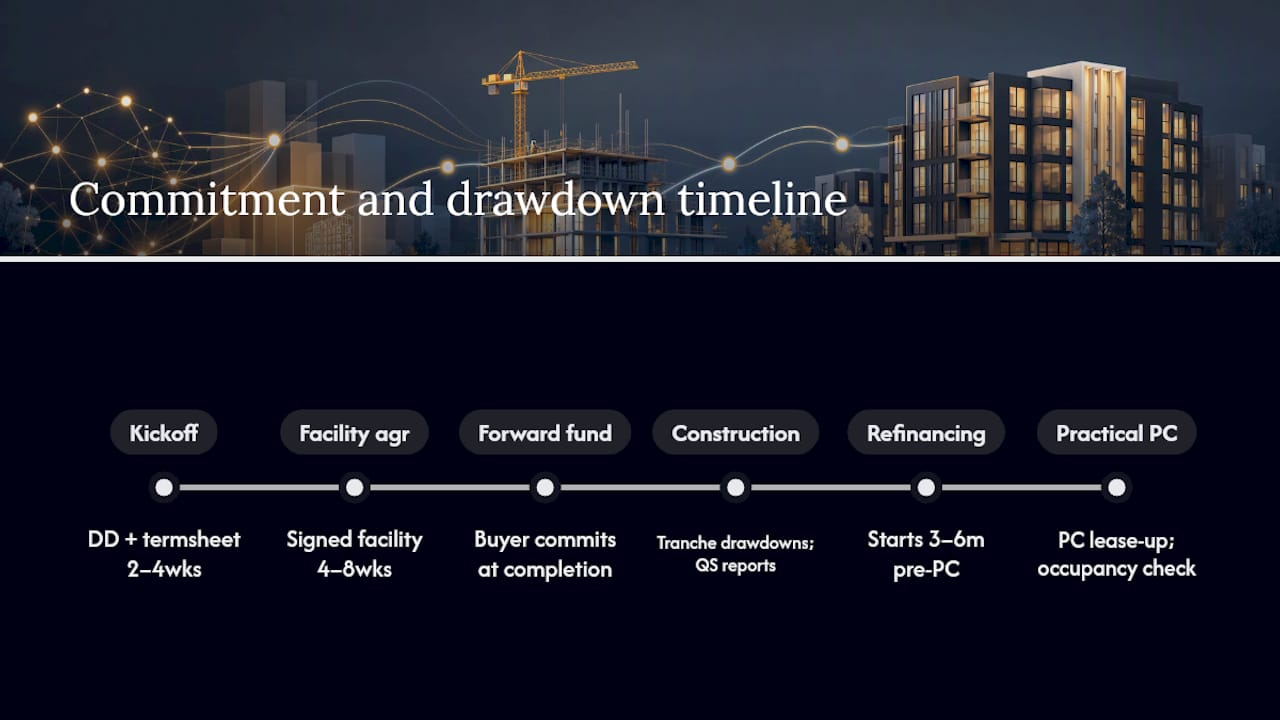
Construction milestones then dictate drawdown. Development facilities draw in tranches against certified works, so your quantity surveyor’s monitoring reports become part of the ongoing lender relationship, not just a box ticked at completion. Practical completion triggers the shift into lease-up, and this is where many sponsors get caught out: lenders increasingly want to see occupancy evidence before releasing final tranches or agreeing refinance terms, rather than taking a forecast on trust.
Refinancing from development debt into long-term investment debt typically starts three to six months before practical completion, giving enough runway to secure a forward-looking facility rather than scrambling once the development loan matures. For schemes with forward funding or forward commitment agreements already in place, an institutional buyer committing to purchase at completion collapses much of this timeline risk, because the exit is contracted before the first brick goes down.
What documentation do lenders expect for PBSA finance?
Lenders underwriting PBSA want a specific pack, and gaps here are the single biggest cause of delay. At the centre sits the financial model: a lender-grade cashflow showing build costs, drawdown profile, projected rental income by bed type, and sensitivity cases if occupancy or rental growth underperforms.
Planning status matters as much as the numbers. A scheme with full planning permission and discharged conditions is a different proposition to one still working through a Section 106 agreement, and lenders price that uncertainty directly into terms. Alongside this, most lenders want evidence of developer experience, project feasibility and a clear exit strategy, not just a good idea on paper.
Sponsor and operator track record carries real weight too. First-time PBSA developers aren’t automatically excluded, but they typically need a stronger operator partner or a more conservative leverage ask to compensate. Expect to provide:
- A full financial model with GBP cashflows and downside sensitivities.
- Planning documentation, including any conditions still outstanding.
- Nomination agreements or evidence of direct-let demand.
- Sponsor CVs, past scheme performance, and proof of funds for equity contribution.
- A build contract and QS appointment for development facilities.
Getting these documents accurate before your structuring partner approaches lenders saves weeks that a rushed submission simply cannot recover.
How should you structure exits and refinances for PBSA schemes?
Every PBSA development facility has an exit built in from day one, and the strongest sponsors design that exit before they draw the first pound rather than treating it as a problem for later.
The most common route is refinancing development debt into long-term investment debt once the scheme stabilises, typically after two to three lease-up cycles have demonstrated occupancy at target rents. Investment lenders capitalise net operating income rather than lending against cost, so the valuation basis changes entirely at this point, and that’s usually where leverage either improves or tightens depending on how the lease-up actually performed against the original model.
Forward sale to an institutional buyer is the second major route, particularly for larger schemes targeting pension funds or specialist student housing operators. This can be agreed as forward funding, where the buyer’s capital supports construction, or as a forward commitment to purchase on completion, which reduces delivery risk without necessarily bringing institutional cash in during the build.
Refinance triggers deserve attention in the original facility agreement. Development loans typically carry a maturity date tied to practical completion plus a lease-up buffer, and sponsors who negotiate flexibility here, rather than a hard cliff-edge, give themselves room if lease-up runs slower than forecast. Mezzanine and JV equity providers will also have their own exit expectations, often linked to a minimum occupancy or debt yield threshold rather than a fixed date, so aligning these triggers across every layer of the stack avoids one lender forcing an exit before another is ready.
How do you find and appoint a structuring partner for PBSA finance?
Most developers approach two or three banks directly and assume that’s due diligence. It isn’t, because banks each only see the part of the stack they’re prepared to lend against, not the full picture of what’s achievable across senior debt, mezzanine and equity together.
A proper structuring process starts with a capital review: a short exercise where a broker or capital-concierge assesses your scheme against realistic leverage bands, identifies which lender types will actually engage at this stage, and flags where mezzanine or JV equity might be needed to bridge a gap between what a bank will lend and what the project costs.
When appointing a partner, ask direct questions. How many PBSA transactions have they closed in the last two years? Which lender relationships do they hold across specialist banks, private credit funds and family offices, not just high street names? Can they run a genuine competitive process rather than taking your deal to a single relationship lender? A good structuring partner will also be candid about where your scheme is weak, whether that’s an unproven operator or thin pre-let coverage, rather than promising terms they can’t deliver.
Red flags worth watching: upfront fees before any lender engagement, vague answers about which lenders they’ve actually placed PBSA deals with, and reluctance to put anything in writing about likely leverage or pricing. A credible partner will give you an honest capital-stack view within days, not weeks.
Case studies: how PBSA capital stacks actually come together
Consider a 220-bed scheme in a mid-sized university city, fully planned, with a nomination agreement already agreed with the university for 60% of beds. That income certainty typically supports a development facility sized against loan-to-cost, with the sponsor contributing equity ahead of drawdown and a mezzanine layer bridging the gap between senior debt and total cost, priced well above senior terms but below what pure equity would demand.

A second scenario: a direct-let scheme in a smaller town with no institutional nomination backing. Here, lenders lean more conservatively because annual re-letting risk sits entirely with the sponsor. Structuring partners typically respond by building in a longer lease-up buffer before refinance and often introducing JV equity rather than mezzanine, since equity partners can absorb occupancy risk that a straight lender can’t underwrite comfortably.
A third pattern, increasingly common through 2026, involves forward funding: an institutional investor commits to fund construction against a forward purchase agreement, effectively removing much of the sponsor’s development finance requirement and replacing it with a structured drawdown from the eventual buyer. This suits sponsors with strong delivery track records but limited balance sheet capacity, trading some upside for certainty.
Timelines across these three patterns vary meaningfully. The nominated scheme typically moves from termsheet to drawdown fastest, since income certainty reduces underwriting friction. The direct-let scheme takes longer at refinance stage, as lenders wait for occupancy proof. The forward-funded scheme often has the longest initial negotiation but the smoothest construction phase, since much of the capital risk has already been transferred.
How James William & Co Capital structures PBSA capital stacks
Running three or four lender conversations at once, while also negotiating mezzanine terms and keeping your equity partner informed, is a full-time job most developers don’t have spare capacity for. That’s the practical gap James William & Co Capital fills.
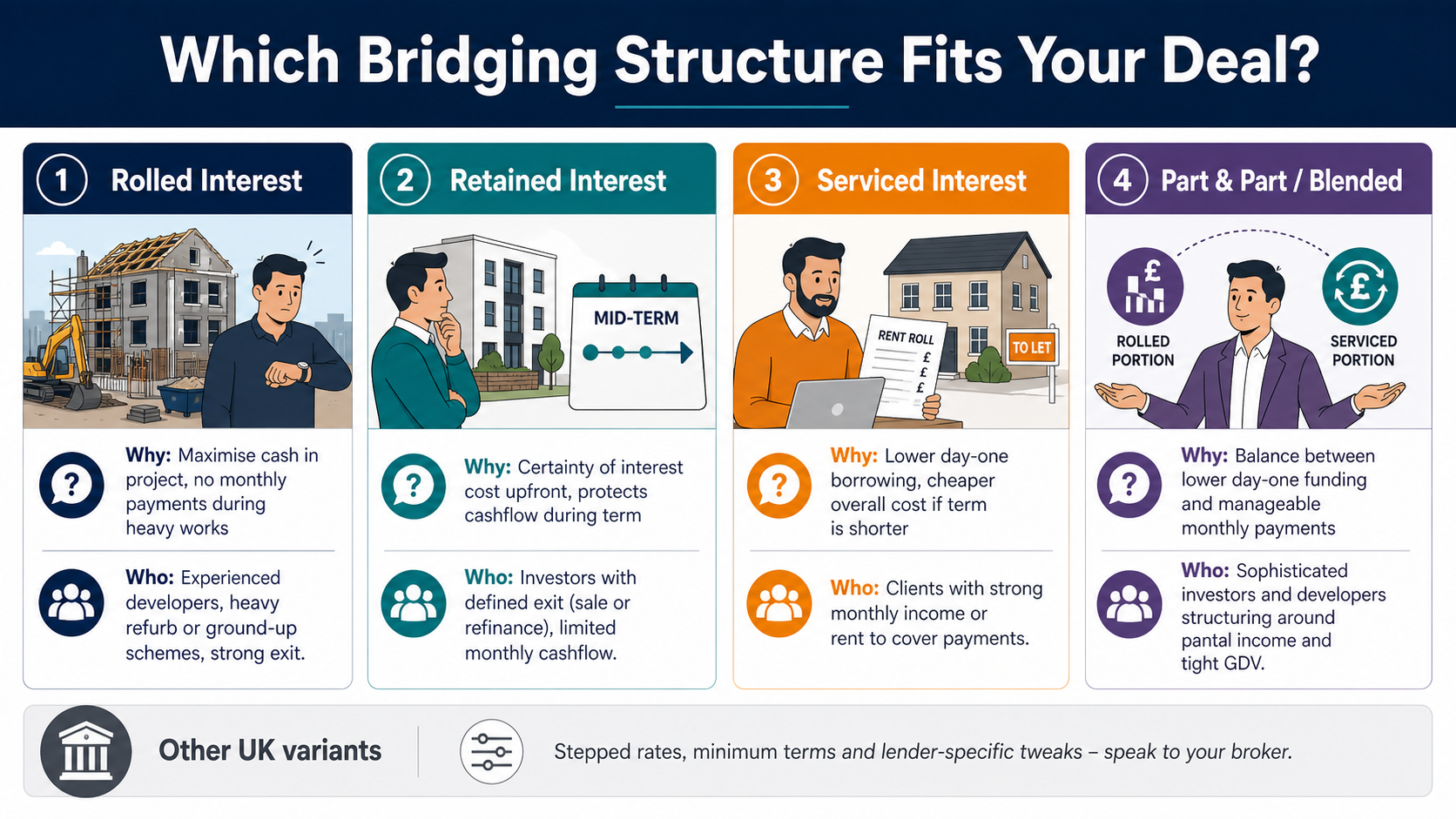
Acting as a capital-concierge, James William & Co Capital sources senior debt, arranges mezzanine or JV equity, structures bridging finance where a gap needs covering, and manages the refinance into long-term investment debt once your scheme stabilises. The firm’s structured finance work is led by James William Dawes, and covers the full range of tools a PBSA sponsor typically needs: bridging, development finance, mezzanine debt and JV equity, negotiated directly with specialist banks, private credit funds and family offices rather than a single relationship lender.
If you’re approaching the market for the first time, or you’ve been quoted terms that don’t reflect your scheme’s income certainty, request an initial capital review. The firm will run a short list of lenders against your scheme, give you a realistic view of leverage and pricing within days, and outline what a termsheet timeline looks like for your specific stage. Get in touch through the London property finance team to start that conversation.
What actually wins PBSA deals in 2026
Sponsors who treat their scheme as one uniform risk lose ground to those who don’t. Lenders now underwrite development, lease-up and stabilised assets as three separate exercises, each with its own leverage ceiling and covenant expectations. The sponsors who negotiate hardest on timing flexibility, not just headline pricing, tend to come out ahead when lease-up runs slower than the model predicted.
Sources
Review current PBSA pricing context and staged underwriting practice reported by Shawbrook’s PBSA lending, or explore property finance types for lender categories.
This article is general information, not a substitute for advice from a qualified financial advisor. Consult a qualified financial professional about your own circumstances before acting on anything here.
- Student Accommodation Finance in 2026: What Gets Funded and on What Terms
FAQ
What is student accommodation finance?
It refers to the structured debt and equity used to develop, acquire or refinance purpose-built student accommodation, typically combining senior debt, mezzanine or JV equity and bridging finance arranged as one coordinated stack.
How much deposit or equity do I need for a PBSA development?
Equity requirements vary by scheme and lender, but sponsors typically contribute equity ahead of senior debt drawdown, with the exact percentage depending on loan-to-cost limits and whether mezzanine is used to reduce the equity gap.
What interest rates apply to PBSA finance in 2026?
Indicative 2026 bands put stabilised investment debt around 5.5% to 7.5% all-in, mezzanine between 11% and 18% per year, and bridging at roughly 0.7% to 1.1% per month, though actual pricing depends on income certainty and sponsor track record.
How long does it take to secure PBSA finance?
Initial due diligence typically takes two to four weeks, with a further four to eight weeks to reach a signed facility agreement, depending on legal complexity and whether JV equity is involved.
Can James William & Co Capital help with foreign or offshore sponsors?
Yes, the firm structures deals involving offshore vehicles and bespoke covenant packages, and documentary requirements for non-UK sponsors are broadly covered by guidance on what foreign nationals need for a UK mortgage.
Recommended
Related Topics
Speak to a specialist
Discuss your finance with James directly
Whole-of-market specialist finance — bridging, development, commercial and residential. No call centres, no obligation. James reviews every enquiry personally.
New to specialist finance? How unbiased broker advice works · Deals we have completed
Explore Related Finance