
Published
title split financeTitle Split Finance: How It Works and How to Fund It
By James Dawes, CeMAP, Founder, James William & Co Capital

Title split finance is funding built around a property that is being divided into separate legal titles, most often a freehold block of flats that becomes individual long-leasehold units. Lenders value and price single units differently from a whole block, so a well-run split can lower the cost of borrowing and widen your exit options. It only works if the legal steps are done in the right order. This guide sets out how a split works in England, what lenders look at, what it costs, and how we approach structuring the funding.
TL;DR
- A title split separates one registered title into two or more, usually by creating long leases or transferring part of a freehold. HM Land Registry then creates the new title numbers.
- If the property is mortgaged, the existing lender must consent in writing before the split can be registered.
- Registration is not automatic and can be slow, so the funding should be structured to cover the wait.
- Splitting your own title does not itself trigger SDLT or CGT. Both arise when a unit is sold or transferred.
- Bridging, commercial mortgage and buy-to-let funding can each play a part at different stages. The right mix depends on your exit.
Table of Contents
- What title split finance actually is
- Why investors split titles
- Which properties and projects suit a split
- The legal steps that shape your funding
- What lenders assess before they fund a split
- Funding routes at each stage
- Costs, tax and planning
- Risks and exit options
- Perspective
- Funding a title split with us
- FAQ
- Sources
What title split finance actually is
A title split is a legal exercise before it is an investment one. A single registered title is divided into two or more, which might involve creating a new leasehold title, transferring part of a freehold, or separating individual units within a larger property. Solicitors describe it as dividing an existing registered freehold title into new titles, typically by applying to HM Land Registry.
Title split finance is the borrowing that sits around that process. It can cover:
- the purchase of a block you intend to split
- the works and legal costs needed to make each unit self-contained
- the period between completion and registration of the new titles
- the refinance of the individual units afterwards
The appeal is simple. For multi-unit freehold blocks, lenders tend to price single long-leasehold flats more favourably than a whole freehold block, so a split can reduce the cost of finance as well as raise the exit value.
Why investors split titles
There are two drivers: value and funding cost.
On value, one industry source suggests that the aggregated value of title-split single-let units may be 25% to 35% higher than the unsplit block. That is a claim from a title splitting specialist, and the figure depends heavily on the building, the location and the comparables, so treat it as a ceiling to test rather than a target.
On funding cost, the same source notes that portfolio and commercial rates have been higher than individual buy-to-let rates. It illustrates the point with a £500,000 mortgage over five years, where access to individual buy-to-let pricing could save around £50,000 in interest compared with a multi-unit freehold block commercial mortgage. Rates move constantly, so the useful lesson is the gap between the two types of lending, not the headline numbers.
A split can also give you flexibility. You can keep some units for income and sell others, which lets you recycle capital rather than holding a single illiquid block.
Which properties and projects suit a split
The most common candidate is a multi-unit freehold block (MUFB): a building of flats held on a single freehold title. Each flat can be given its own long lease, so that it can be sold or mortgaged on its own.
Other candidates tend to share the same features:
- Self-contained units. Each unit needs its own entrance or clearly defined access, and its own services where practical.
- Independent access. Every new title needs unambiguous access, with shared routes documented by express easements in the legal paperwork.
- A sensible layout. A unit that cannot function on its own, for example one reached only through another unit, causes problems with valuers and lenders.
- Conversions. A single house converted into flats is a material change of use, which typically needs planning permission, and building regulations approval for fire separation, sound insulation and means of escape is almost always required.
If your project is a ground-up scheme or a conversion with significant works, the funding conversation starts earlier, with development finance, and the split comes at the end. Our guide to types of property finance for UK developers sets out how those products fit together.
The legal steps that shape your funding
The legal sequence matters because every stage affects what a lender will advance and when. A typical order is a feasibility check, a surveyor’s plan, lender consent, the legal documents, and then Land Registry registration, as outlined by a title plan specialist.

Feasibility and the plan
Before any application, a solicitor and surveyor confirm that the building can be divided cleanly. HM Land Registry expects plans drawn to a stated scale, typically 1:1250 for location and 1:500 for the title plan, with a north point, a scale bar and the new title boundary edged in red. A poor plan is a common reason for a requisition, so it is worth paying for a competent one.
Lender consent
If the property is mortgaged, the existing lender has to agree. HM Land Registry’s guidance says that when you apply to split a title subject to a charge, you must explain why the split is needed and include a copy of the lender’s written confirmation. The existing charge sits over the whole title, so it has to be varied or released as units are dealt with. Treat consent as step one, not a formality at the end.
The documents
The split is usually done through a Transfer of Part (TP1) or by granting new leases. A lease needs two distinct legal parties, a landlord and a tenant. That is why split structures commonly involve two companies: one that holds the freehold and one that takes the leases. Your solicitor will design this around your own circumstances, and your funder’s solicitor will review it.
If you or a co-signatory are overseas and cannot sign in person, remote notarisation of documents can save time on the paperwork side, though your solicitor should confirm what the Land Registry and the lender will accept.
Registration
Once the application is lodged, Land Registry creates the new title numbers. Do not assume this is quick. One specialist consultancy reports that registration is discretionary, not automatic, and that it can take around 18 months if left alone, with three to six months a realistic target if you chase actively. Build the wait into your funding plan from the start.

What lenders assess before they fund a split
Whoever lends will look at the same core issues, and each one is worth preparing for before you approach them.
- Legal security. The lender’s own solicitor must review the structure, the leases and the title. The cleaner your documents, the faster this goes.
- Valuation basis. Is the value based on the block as a whole, or on the individual units? Comparable sales of similar flats in the area carry weight.
- Your exit. Will you sell the units, refinance them individually, or hold them? Lenders want a credible, evidenced route to repayment.
- Your experience and the strength of the deal. Track record, the financial position of the borrower and the structure of the vehicles involved all feed into terms.
- Condition of the building. Where works are needed to make units self-contained, the lender will want a costed scope.
There is also a timing question: can you borrow before the new titles exist? Some lenders will lend where the split happens on completion, subject to legal review, valuation and underwriting. Others want registration first. On refinancing afterwards, most lenders ask for the title to have been registered for six or even twelve months, although a handful will consider day-one remortgages. That 2021 piece pre-dates today’s market, so the lender appetite will have shifted. Check current criteria through a broker rather than relying on an old rule of thumb.
Lenders’ criteria on newly split titles have also been changing. We would rather you hear that from a broker with live panel knowledge than rely on a product that was on the shelf last year.
Funding routes at each stage
No single product covers a split from start to finish. Most deals use a sequence.
| Stage | What you need | Typical product |
|---|---|---|
| Acquisition of the block | Speed, flexibility on property condition | Bridging finance or a commercial mortgage |
| Works to make units self-contained | Staged drawdowns against costs | Development finance |
| Waiting for registration | A facility that runs long enough | Bridging with a term that allows for registration delays |
| Refinance of units | Lower, longer-term borrowing on individual flats | Buy-to-let mortgages |
Where equity is thin, a layered structure can bring the numbers together. Mezzanine debt or joint venture equity can sit behind a senior loan to reduce the cash you put in. Our pieces on structured property finance and how to structure a development deal when margins are tight explain how stacked debt works. If the buying vehicle is held offshore, there are extra requirements, covered in our offshore SPV mortgage guide.
The key is to match the term of each facility to the realistic length of the legal process. A short bridge on a split that takes a year to register is a refinancing risk waiting to happen.
Costs, tax and planning
A title split has three layers of cost, as a property tax adviser sets out:
- Transaction costs: conveyancing for the transfers and new leases, surveyor and valuation fees, planning and building regulations fees, lender consent or refinancing costs, and HM Land Registry fees for each new title.
- Construction costs: fire separation, sound insulation, separate services and metering, and the works needed to make units genuinely self-contained.
- Tax costs: see below.
If the building has older fabric, a damp and condition survey before you commit helps you price the works realistically, and it gives a lender a clearer picture of what you are buying.
We have not quoted a fixed cost per split, because legal and survey fees vary with the size and complexity of the building. Ask your solicitor for a fee estimate before you fix your funding requirement, and add a contingency.
Stamp Duty Land Tax
Splitting your own title does not, in itself, trigger SDLT. SDLT becomes relevant when a unit is sold or transferred to another person or to a company, and the 5% higher-rate surcharge applies to the whole price for an additional dwelling. If a transfer between your own companies is part of the structure, take specific advice on SDLT before you proceed.
Capital Gains Tax
A title split is not, by itself, a disposal for CGT purposes. The event is the sale or transfer of a unit afterwards. For disposals in the 2026/27 tax year, gains on UK residential property are charged at 18% within the basic-rate band and 24% above it. Because the tax outcome depends on who owns what and when, speak to a qualified property tax accountant before exchange, not after. The timing of any beneficial-interest transfer can change who bears the gain.
Planning and building regulations
The split itself is a legal change, not a physical one. If you are altering the building, for instance converting a house into flats, you will need planning and building control approval as above. Confirm this with the local planning authority for your building.
Risks and exit options
The main financial risk is being over-leveraged when values move. Industry commentary points to exposure over a five-year fixed-rate period if values drop, and suggests mitigating this by making sure units can be sold or refinanced individually.
Practical risks are mostly about process:
- Skipping lender consent. Splitting a mortgaged property without consent can breach your mortgage conditions and stall the application.
- Registration delays. A bridge that expires before the titles exist is the classic problem.
- Poor access or layout. Units that do not stand alone are harder to value, mortgage and sell.
- Late splitting. Leaving the split until sale can run into changes in the tax landscape, or a lender that will not release one unit at a time. Splitting early, ideally on purchase, is often recommended by specialists for this reason.
Your exit options generally fall into three groups:
- Sell all units and repay the debt from proceeds.
- Sell some, keep some, using the sales to pay down the loan and refinance the rest onto longer-term buy-to-let funding.
- Hold everything and refinance each unit individually, or the block as a whole, once the titles are registered.
Write the exit down before you borrow, with a fallback if the first choice slips. Lenders will ask for it, and you should too.
Perspective
Most split deals that struggle do not fail on the numbers. They fail on sequencing: consent obtained too late, a bridge that is too short, or a refinance plan built on a lender policy that has since changed.
Our view is that the funding should be designed backwards from the exit. Decide whether you are selling, refinancing or holding, work out how long registration might realistically take, and then choose facilities that outlast it with room to spare. That is where access to specialist lenders and private credit funds, beyond the high street banks, earns its keep.
We work as a single point of contact across bridging, development finance, commercial mortgages, mezzanine debt and joint venture equity, so the stages of a split do not have to be funded by strangers who never speak to each other. If a deal needs a layered structure, we build it around the project, not the other way round.
James William Dawes
Funding a title split with us
We are a specialist broker arranging property and business finance for developers, investors and high-net-worth clients across the UK. For a title split, we can look at the whole sequence with you: the acquisition or bridge, any works funding, the period before registration, and the refinance onto individual units. We work with a network of specialist lenders, family offices and private credit funds, and we aim to move quickly on time-sensitive deals.
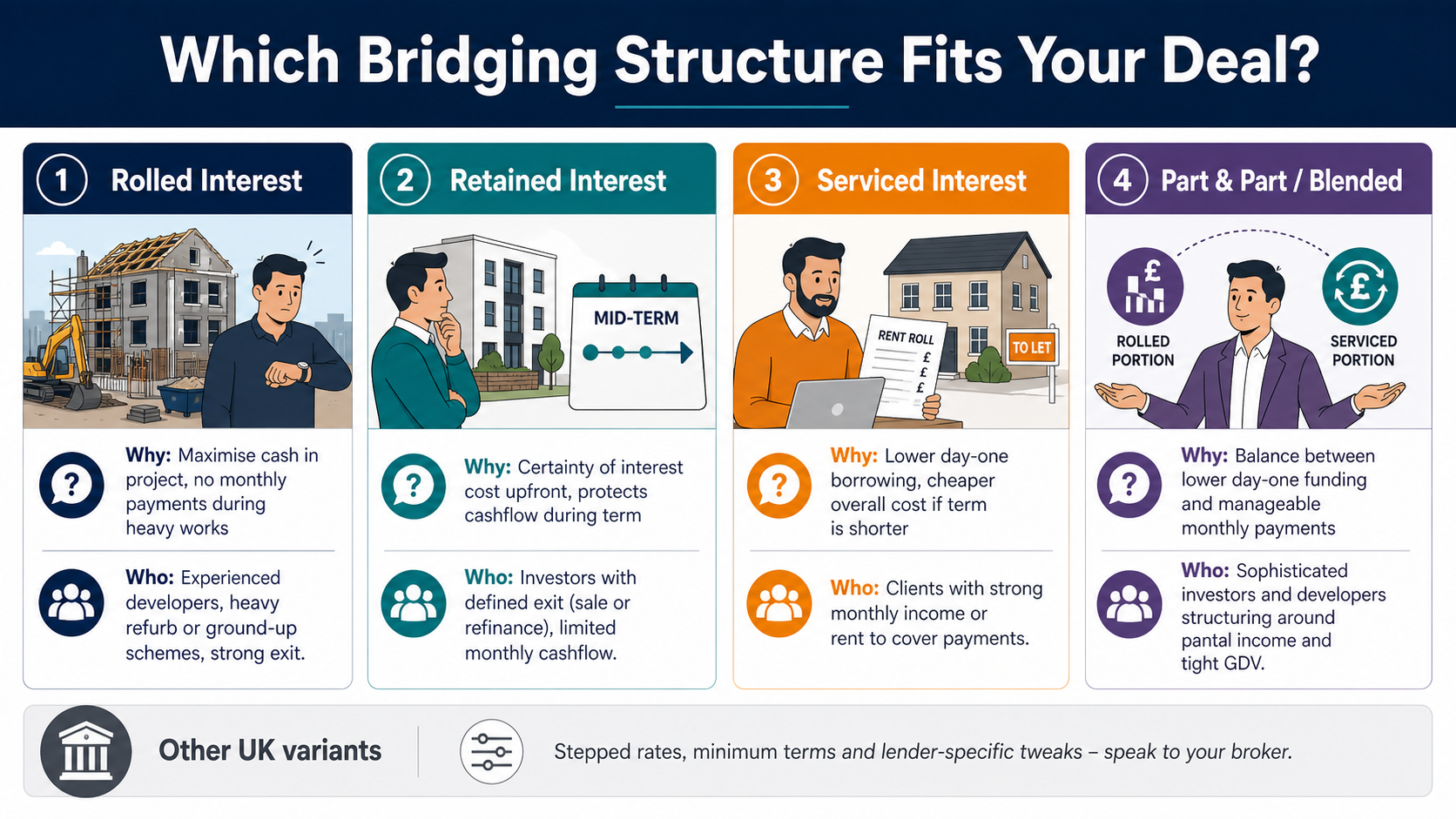
If you are weighing up a split, start with our bridging finance page or talk to us through the main site and tell us about the building, your exit and your timetable.
FAQ
Can I get finance before the new titles are registered?
Sometimes. Some lenders will fund where the split is carried out on completion, subject to legal review, valuation and underwriting, while others prefer registered titles first. Your solicitor and the lender’s solicitor will both be involved, so allow time for both sides to review the documents.
Does a title split trigger Stamp Duty or Capital Gains Tax?
Splitting your own title does not in itself trigger either. SDLT and CGT usually arise when a unit is sold or transferred afterwards. Your circumstances and ownership structure change the outcome, so take advice from a property tax accountant before you exchange.
How long does a title split take?
The legal work and the Land Registry registration are separate clocks. Registration is discretionary and can take months, with one specialist reporting around 18 months if left alone and three to six months with active chasing. Plan your facility term around the slower figure.
Do I need lender consent if the building is mortgaged?
Yes. HM Land Registry requires the existing lender’s written confirmation to be included when you apply to split a title that is subject to a charge. Without it, you risk breaching your mortgage conditions and stalling the application.
What type of lender will fund a split?
It depends on the stage. Bridging lenders tend to fund acquisitions and the waiting period, development lenders fund works, and buy-to-let lenders take the refinanced individual units. A broker can match each stage to current lender appetite.
Sources
- HM Land Registry: splitting a title subject to a charge
- Mercantile Trust: title splits and bridging loans
- Fosters Solicitors: what is title splitting
- UK Property Accountants: title splits guide
- UK Property Accountants: CGT on title splits
- Title Split: reasons investors are splitting
- Survey Merchant: title split plans
- The Title Split Consultant: process step by step
- Mortgage Introducer: day one remortgages
- Online notary for real estate
- Home condition survey
Recommended
- Conversion Finance vs New Build: Which Funding Fits?
- How to Structure a Development Finance Deal When Margins Are Tight
- Bullet vs Amortising Loans in UK Property Finance: Plan the Exit First
You must keep up your repayments to avoid repossession. We are not a lender. James William & Co Capital Ltd is an Appointed Representative of Flexi Network Ltd, FRN: 1060247. Flexi Network Ltd is authorised and regulated by the Financial Conduct Authority, FRN: 948658. Flexi Network Ltd is an authorised credit broker and not a lender. You can verify both on the Financial Services Register at register.fca.org.uk.
Related Topics
Speak to a specialist
Discuss your finance with James directly
Whole-of-market specialist finance — bridging, development, commercial and residential. No call centres, no obligation. James reviews every enquiry personally.
New to specialist finance? How unbiased broker advice works · Deals we have completed
Explore Related Finance