
Published · Updated
explaining term sheetsTerm Sheets Explained: A Guide for Property Borrowers
By James Dawes, CeMAP, Founder, James William & Co Capital

A term sheet is a short document that captures the principal commercial and legal terms of a proposed investment and sets the framework for the deal that follows. According to the British Business Bank, it acts as a non-legally binding roadmap to the definitive investment agreements, aligning both parties on valuation, control, and the big-ticket items before anyone spends serious money on legal drafting.
Three things every founder should know immediately:
- Valuation drives dilution. The pre-money valuation figure determines what percentage of your company you give away. Get this wrong and every subsequent round compounds the problem.
- Some clauses are binding right now. Confidentiality, exclusivity, and governing law provisions can be legally enforceable even when the rest of the document is labelled “subject to contract.”
- Reserved matters affect control. A broad reserved matters list means investors can block ordinary business decisions. This is not boilerplate — it is a control mechanism.
Your three-item micro checklist:
- Read the valuation and investment amount first, then work out the post-money maths yourself.
- Flag any clause that uses obligatory language (“shall”, “must”, “agrees to”) outside the main commercial terms.
- Call a specialist VC lawyer before you sign, not after.
Key takeaways
A term sheet is a non-binding roadmap to your investment agreement, but the clauses you accept today will shape your ownership, control, and exit proceeds for the life of the company.
| Point | Details |
|---|---|
| Calculate dilution immediately | Work out post-money ownership before responding to any term sheet. |
| Some clauses bind you now | Confidentiality, exclusivity, and cost obligations can be legally enforceable from signing. |
| Reserved matters determine control | Negotiate a short list with high thresholds — not a catch-all investor veto. |
| Anti-dilution type matters | Broad-based weighted average is market standard; full ratchet is a red flag. |
| Get a VC lawyer before signing | Specialist legal advice at seed stage costs far less than fixing a bad term sheet later. |
Table of Contents
- What is a term sheet and is it legally binding?
- Key clauses in a term sheet and what they mean for founders
- How the term sheet process works from offer to completion
- How to read and negotiate a term sheet: a founder’s playbook
- An annotated mini term sheet: what the language actually looks like
- When do you need a lawyer, and how do you choose one?
- What founders consistently get wrong: a perspective from the deal table
- Sources
- FAQ
What is a term sheet and is it legally binding?
A term sheet summarises where both parties stand on the principal commercial and legal terms before the expensive work of drafting long-form documents begins. Think of it as a handshake in writing: it records what has been agreed in principle so that lawyers can translate it into a shareholders’ agreement, articles of association, and subscription agreement without relitigating the fundamentals.
The standard position is that a term sheet is “subject to contract” and therefore not legally binding. That said, the picture is more nuanced than most founders realise.
Courts look at the actual wording, not just the label at the top of the document. If a clause says a party “shall” keep information confidential or “agrees not to” approach other investors for 30 days, a judge may treat that obligation as immediately enforceable regardless of the surrounding “subject to contract” language. The practical lesson: read every clause, not just the headline numbers.
There is also a reputational dimension. As Osborne Clarke notes, term sheets are often treated as “binding in honour” — once core commercial points are agreed, walking away or renegotiating damages your reputation in a market where investors talk to each other constantly.
Where the term sheet sits in the deal timeline:
| Stage | Typical duration |
|---|---|
| Offer and initial negotiation | 1–3 weeks |
| Sign term sheet | Day 1 of exclusivity |
| Due diligence | 4 weeks |
| Drafting long-form documents | 3–6 weeks |
| Completion | 1–2 weeks |
Total elapsed time from first term sheet to completion typically runs 10–20 weeks for a seed round and can extend to six months or more for a Series A with complex governance.
Key clauses in a term sheet and what they mean for founders
Clause literacy is the difference between a founder who negotiates and one who just signs. The clauses below cover the full scope of what you will encounter, from the economics that determine your ownership to the governance provisions that determine your autonomy.
Investment amount and valuation
The investment amount is straightforward: the sum the investor commits to put in. Valuation is where founders most often make errors. Pre-money valuation is what the company is worth before the investment arrives. Post-money valuation is pre-money plus the investment. Your ownership percentage after the round equals your shares divided by the total post-money share count — so a £5m pre-money valuation with a £1m investment gives a post-money of £6m and the investor roughly 16.7% of the company.
Seed rounds in the UK commonly use a pre-money valuation agreed between parties, while Series A rounds often involve more formal financial modelling. SeedLegals publishes practical guidance on which valuation mechanics are negotiable and which tend to be market standard at each stage.
Share class and preference rights
Investors almost always receive preferred shares rather than ordinary shares. Preferred shares carry rights that ordinary shares do not: priority in a liquidation, sometimes a guaranteed return, and often enhanced voting rights. The specific rights attached to preferred shares are what make the difference between a fair deal and a punishing one.
Liquidation preference
This clause determines who gets paid first when the company is sold or wound up. A 1x non-participating liquidation preference means the investor gets their money back before ordinary shareholders receive anything, but does not participate further in the upside. A participating preference (sometimes called “double-dip”) lets the investor take their preference amount AND share in the remaining proceeds alongside ordinary shareholders. Participating preferences are increasingly rare at seed stage in the UK but still appear at Series A.
Anti-dilution
Anti-dilution provisions protect investors if you raise a future round at a lower valuation (a “down round”). Broad-based weighted average anti-dilution is the market-standard, founder-friendly version: it adjusts the investor’s conversion price based on a formula that accounts for all shares outstanding. Full ratchet anti-dilution is the aggressive version: the investor’s price resets to the new lower price regardless of how small the down round is, which can devastate founder ownership. Push back hard on full ratchet.
Board composition and reserved matters
Gov is explicit: board composition and reserved matters are critical guardrails that must balance investor protections and founder autonomy. A typical seed board might be two founders, one investor director, and one independent. Reserved matters are the list of decisions that require investor consent — things like issuing new shares, taking on debt above a threshold, or changing the business plan. The longer this list, the more control investors have over day-to-day operations.

Drag-along and tag-along rights
Drag-along allows a majority of shareholders to force minority shareholders to sell their shares in an exit. Without it, a small minority can block a trade sale. Tag-along gives minority shareholders the right to join a sale on the same terms if a majority decides to sell.
Founder vesting and leaver provisions
Vesting schedules mean founders earn their shares over time, typically over four years with a one-year cliff. This protects investors if a founder leaves early. Good leaver provisions allow a departing founder to keep vested shares at fair market value. Bad leaver provisions (resignation, dismissal for cause) often allow the company to buy back shares at cost or nominal value. The definitions of “good” and “bad” leaver matter enormously — negotiate them carefully.
Information rights, use of funds, and closing conditions
Investors will want regular financial reporting (monthly or quarterly management accounts, annual audited accounts). Use-of-funds clauses specify what the investment can be spent on, and milestone conditions may tie tranches of funding to hitting specific targets. Closing conditions are the hurdles that must be cleared before money changes hands: regulatory approvals, shareholder consents, and satisfactory due diligence.
Clause comparison: founder-friendly vs investor-friendly positions
| Clause | Founder-friendly | Investor-friendly |
|---|---|---|
| Liquidation preference | 1x non-participating | 2x participating |
| Anti-dilution | Broad-based weighted average | Full ratchet |
| Board composition | Founder majority | Investor majority or equal split |
| Reserved matters | Short, high-threshold list | Long, low-threshold list |
| Vesting | 4-year, 1-year cliff, good leaver = FMV | Accelerated bad leaver triggers, nominal value |
| Drag-along threshold | 75%+ majority | Simple majority |
| Exclusivity period | 30 days or fewer | 60+ days, unconditional |
How the term sheet process works from offer to completion
Receiving a term sheet feels like a milestone — and it is — but it is also the start of the most consequential negotiation you will have as a founder. Here is how the process typically unfolds.
Step 1: Receiving the offer. An investor sends a term sheet, usually after verbal agreement on headline economics. Read it in full before responding. Do not let enthusiasm push you into a quick sign-off.
Step 2: Negotiating economic and control terms. Focus first on valuation, liquidation preference, and anti-dilution. Then move to governance: board seats, reserved matters, and information rights. Most investors expect some negotiation; a well-prepared founder who pushes back on specific, justified points signals competence rather than difficulty.
Step 3: Exclusivity. Once the term sheet is signed, the exclusivity (no-shop) period begins. Sprintlaw UK notes that founders should negotiate both the length of exclusivity and any caps on legal cost obligations before signing. A 30-day exclusivity window is reasonable for seed; 60 days is common for Series A. Unconditional, open-ended exclusivity with no cost cap is a red flag.
Step 4: Due diligence. The investor’s legal and financial team will review your corporate records, IP ownership, contracts, cap table, and financial statements. Prepare a data room in advance. Gaps in documentation extend timelines and erode investor confidence.
Step 5: Drafting long-form documents. The term sheet becomes the instruction manual for lawyers drafting the shareholders’ agreement, articles of association, and subscription agreement. As Osborne Clarke points out, changes to articles may require a 75% special shareholder resolution — so alignment with existing shareholders must be confirmed early.
Step 6: Completion. Funds transfer once all conditions are satisfied and documents are executed. Build in buffer time: completion rarely happens on the first target date.
Costs to expect: Founder-side legal fees for a seed round typically run £5,000–£15,000; Series A legal costs can reach £30,000–£60,000 or more depending on complexity. Investors often require founders to contribute to their legal costs — negotiate a cap (commonly £10,000–£20,000 at seed) and make it conditional on the deal completing.
How to read and negotiate a term sheet: a founder’s playbook
Most founders read a term sheet front to back and react to whatever catches their eye first. That is the wrong approach. Work through it in a deliberate sequence.
Reading sequence:
- Investment amount and pre-money valuation — calculate post-money and your diluted ownership immediately.
- Share class and liquidation preference — understand what investors receive before you in an exit.
- Anti-dilution mechanics — identify the type and assess your exposure in a down-round scenario.
- Board composition and reserved matters — count the seats and read every item on the reserved matters list.
- Vesting and leaver provisions — check the definitions of good and bad leaver, and the cliff period.
- Exclusivity and confidentiality — note the duration and any cost obligations.
- Closing conditions and milestones — understand what must happen before money arrives.
Negotiation moves that actually work
On valuation: investors anchor on pre-money. You can counter by adjusting the option pool timing — an option pool created before the investment (pre-money) dilutes founders; one created after (post-money) dilutes everyone including the investor. Know which the term sheet assumes.
On liquidation preference: if an investor insists on a participating preference, propose a cap (e.g. This limits the double-dip without removing the investor’s downside protection.
On anti-dilution: broad-based weighted average is the market standard. If an investor proposes full ratchet, ask them to justify it. In most seed deals, there is no justification.
On reserved matters: ask for a threshold. “Incurring debt above £ X” is reasonable. “Incurring any debt” is not. Push for materiality qualifiers on every item.
On vesting: if you have been building the company for three years before raising, negotiate for partial credit (a “cliff waiver” or accelerated start). Investors who refuse this on a mature founding team are signalling something worth noting.
Red flags founders should not ignore
- A participating liquidation preference above 1x with no cap.
- Full-ratchet anti-dilution with no carve-outs for small issuances.
- Reserved matters that include routine operational decisions (hiring below a salary threshold, signing contracts below a low value).
- Exclusivity longer than 45 days with no cost cap and no termination right for the founder.
- Broad warranties from founders personally, not just the company.
Pro Tip: When you reach the point of negotiating reserved matters, ask the investor to walk you through each item and explain why they need it. Investors who cannot explain a reserved matter in plain English often do not actually need it — and the conversation itself reveals how the relationship will work post-investment.
An annotated mini term sheet: what the language actually looks like
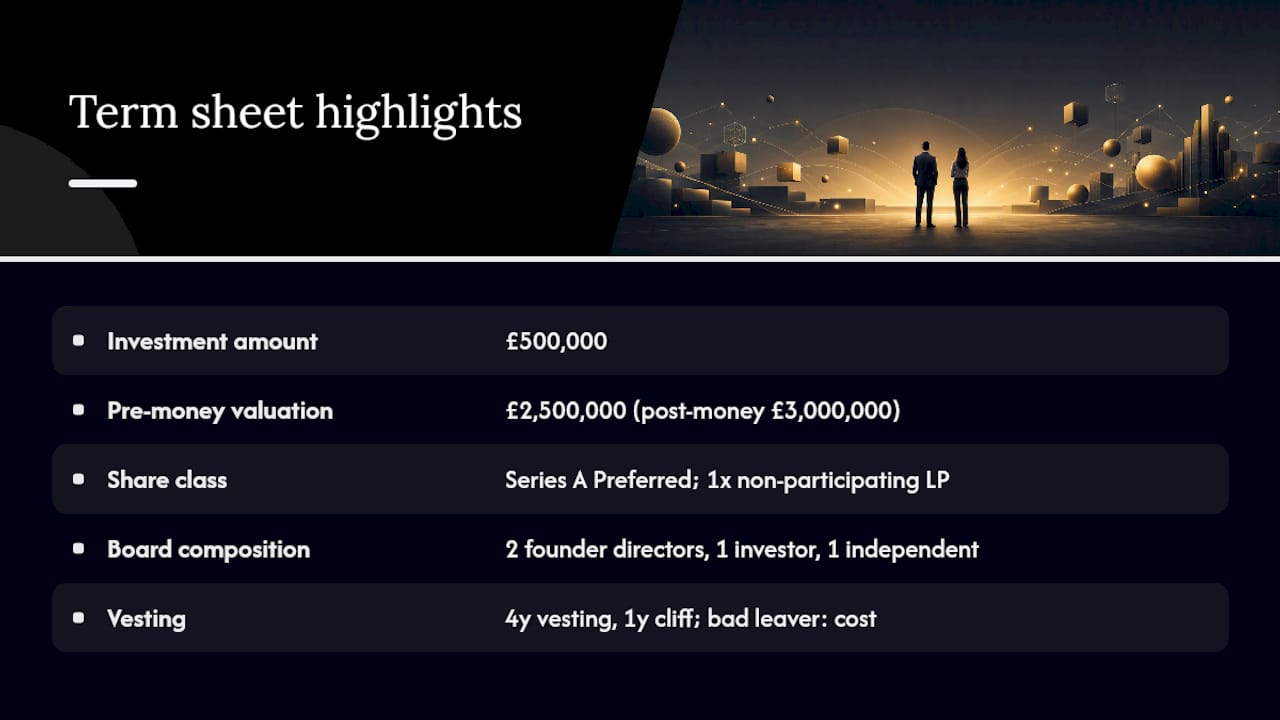
Below is a condensed, annotated example of a seed-stage term sheet. The annotations highlight founder-friendly signals, investor-friendly signals, and language that may indicate binding intent.
TERM SHEET — ILLUSTRATIVE SEED ROUND Subject to contract (except where stated otherwise)
Investor: [Investor name] Company: [Company name] Date: [Date]
Investment amount: £500,000 Annotation: Straightforward. Confirm whether this is the full round or one tranche.
Pre-money valuation: £2,500,000 Annotation: Post-money = £3,000,000. Founder ownership post-round = existing shares ÷ total post-money shares. Calculate this yourself before responding.
Share class: Series A Preferred Shares, 1x non-participating liquidation preference Annotation: Founder-friendly. Non-participating means the investor takes their £500k back in a downside exit, then steps aside. No double-dip.
Anti-dilution: Broad-based weighted average Annotation: Market standard. Acceptable.
Board: Two founder directors, one investor director, one independent (appointed by mutual agreement) Annotation: Founder majority. Good. Watch for language that gives the investor a veto on the independent appointment.
Reserved matters: Issuance of new shares; incurring debt above £100,000; disposal of material assets; changes to articles of association; approval of annual budget. Annotation: Reasonable scope. The £100,000 debt threshold is workable for most seed-stage businesses. “Material assets” needs a definition — push for a monetary threshold.
Vesting: Four-year vesting, one-year cliff. Good leaver = fair market value. Bad leaver = cost price. Annotation: Standard. Confirm the bad leaver definition — does it include resignation for any reason, or only for cause?
Exclusivity: The Company agrees not to solicit or entertain alternative investment proposals for 30 days from the date of this term sheet. Annotation: This clause is likely binding. Thirty days is reasonable. Note the word “agrees” — obligatory language.
Confidentiality: Each party shall keep the terms of this term sheet confidential. Annotation: Binding. “Shall” is obligatory. Standard and fair.
Costs: Each party bears its own legal costs. The Company shall contribute up to £10,000 towards the Investor’s legal costs, conditional on completion. Annotation: Conditional cost contribution is acceptable. Unconditional cost obligations are not — push back if costs are not tied to completion.
How this changes at Series A: A Series A term sheet typically adds more detailed information rights (monthly board packs, audited accounts within 90 days), a longer reserved matters list with lower thresholds, more complex anti-dilution mechanics, and often a drag-along threshold set at a lower majority. The board may shift to an equal split or investor majority, and founder vesting terms may include acceleration on change of control. NVCA model legal documents provide market-tested clause language that sets customary baselines for these more complex provisions.
When do you need a lawyer, and how do you choose one?
The short answer: before you sign anything. The longer answer is about knowing which moments carry the most risk.
Moments that require specialist legal advice:
- The term sheet includes complex governance provisions or an unusually long reserved matters list.
- The valuation is above £5m or the investment is above £1m (the stakes justify the cost).
- Founder exit terms, drag-along thresholds, or bad leaver definitions are being negotiated.
- The investor is asking for personal warranties from founders rather than company-level warranties.
- The security structure involves convertible instruments, SAFEs, or ASAs rather than straightforward equity.
Choosing the right adviser:
- Specialism matters more than firm size. Look for a lawyer with a dedicated VC or early-stage practice, not a generalist commercial solicitor.
- Ask for two or three recent transactions at a comparable stage and deal size. A lawyer who has done ten seed rounds in the past year knows what is market standard; one who has done two does not.
- Clarify the fee structure upfront: fixed fee, capped hourly, or hourly with an estimate. Fixed or capped fees are preferable for founders managing cash.
- Check for conflicts: does the firm also act for the investor or the investor’s other portfolio companies?
Fee expectations: Founder-side legal fees for a seed round typically run £5,000–£15,000. Series A legal costs can reach £30,000–£60,000 depending on complexity. Investor legal cost contributions are commonly capped at £10,000–£20,000 at seed stage and should always be conditional on completion, as Sprintlaw UK advises.
For founders whose funding needs intersect with property or complex capital structures, capital advisory services can complement legal counsel by stress-testing the financial terms before you commit.
This article is general information, not legal advice. Confirm the terms of any investment agreement with a qualified solicitor before signing.
What founders consistently get wrong: a perspective from the deal table
The clause that founders most often underestimate is not liquidation preference or anti-dilution. It is reserved matters. Every week, founders sign term sheets with reserved matter lists that effectively require investor consent to hire a senior employee, sign a contract above a modest threshold, or pivot the product. They do not notice until six months later, when they need to move quickly and cannot.
The second most common mistake is treating the term sheet as a draft. Once you have verbally agreed the headline economics, renegotiating them is reputationally costly even if the document says “subject to contract.” Osborne Clarke’s observation that term sheets are “binding in honour” is not a legal technicality — it reflects how the VC community actually operates. Investors who feel a founder is relitigating agreed points will either walk away or extract concessions elsewhere to compensate.
The third mistake is ignoring the cap table implications of the option pool. Model it before you respond.
For founders raising against property assets or using development finance as part of a capital stack, the interaction between equity term sheets and structured property finance adds another layer of complexity that most VC lawyers are not equipped to handle alone. Get both disciplines in the room early.
The founders who navigate term sheets well are not the ones who know the most jargon. They are the ones who understand what they are giving up, model the scenarios, and know which battles are worth fighting. Valuation is negotiable. Liquidation preference design is negotiable. A 30-day exclusivity period is not worth a fight. Knowing the difference is the whole game.
Sources
The sources below are worth bookmarking before you enter any term sheet negotiation.
For templates and founder-facing guidance:
SeedLegals publishes one of the most practical founder guides available, with annotated templates and clear guidance on which terms are negotiable at seed stage. It is the best starting point for UK founders who want to understand what market-standard looks like before they see an investor’s draft.
For UK market context and legal status:
The British Business Bank provides a clear, authoritative overview of what a term sheet is and its role in the investment process. The GOV.UK guidance on investment guardrails is particularly useful for understanding board and reserved matter drafting from a policy perspective.
For legal enforceability:
Gowling WLG’s 2026 analysis of Commercial Court guidance on term sheet enforceability is essential reading for any founder who wants to understand exactly which clauses can bind them before long-form documents are signed.
For model clause language:
NVCA model legal documents offer market-tested clause language widely used as a baseline in VC transactions. While US-oriented, they set useful benchmarks for anti-dilution mechanics, drag-along thresholds, and information rights that translate well to UK practice.
For quick concept checks:
Investopedia and Wise both offer accessible, non-legal explainers that are useful for cross-checking basic definitions — particularly for founders who want a plain-English sense-check before a legal conversation.
This article is general information, not a substitute for advice from a qualified financial advisor. Consult a qualified financial professional about your own circumstances before acting on anything here.
- What is a term sheet? | British Business Bank
- VC focus: UK term sheets explained for founders | Osborne Clarke
- Gov
- Term sheets explained: the founder’s guide | SeedLegals
FAQ
Is a term sheet legally binding?
Most of a term sheet is not legally binding — it is typically “subject to contract.” However, specific clauses such as confidentiality, exclusivity, and governing law are often enforceable immediately, particularly where the language uses obligatory terms like “shall” or “agrees to.”
Can you give an example of a term sheet?
The annotated mini template in this article illustrates typical phrasing for each clause.
What are the different types of term sheets?
Term sheets vary primarily by funding stage (seed, Series A, Series B and beyond) and instrument type (equity, convertible note, SAFE, or ASA). Equity term sheets are the most detailed; convertible instruments are simpler but carry their own conversion mechanics that affect dilution at the next priced round.
What is the difference between a term sheet and an MOU?
A memorandum of understanding (MOU) is a broader statement of intent between parties, often used in commercial partnerships or acquisitions. A term sheet is specific to an investment transaction and sets out the precise commercial and legal terms that will be translated into binding investment documents. Both are generally non-binding, but a term sheet is more detailed and deal-specific.
Recommended
Related Topics
Speak to a specialist
Discuss your finance with James directly
Whole-of-market specialist finance — bridging, development, commercial and residential. No call centres, no obligation. James reviews every enquiry personally.
New to specialist finance? How unbiased broker advice works · Deals we have completed
Explore Related Finance