
Published · Updated
maintenance vs incurrence covenantsMaintenance vs incurrence covenants: the practical distinction
By James Dawes, CeMAP, Founder, James William & Co Capital

Maintenance covenants force a borrower to hit specific financial ratios at regular intervals, whether or not anything else is happening in the business. Incurrence covenants only bite when the borrower actually tries to do something, like raise new debt or pay a dividend. That single distinction changes everything about how a breach unfolds: fail a maintenance test and you’re in technical default even if you can pay every bill on time; fail an incurrence test and the proposed transaction simply doesn’t happen.
For anyone underwriting, negotiating or advising on a UK loan agreement, this is the fork in the road. Maintenance tests are usually run quarterly, based on figures pulled from compliance certificates the borrower delivers to the lender. Incurrence tests are only calculated at the moment a specific action is proposed, using pro forma numbers that assume the transaction has already gone through.
The three tests you’ll see most often across both regimes are leverage (net debt to EBITDA), interest cover, and fixed charge or debt service coverage. Loan Market Association drafting conventions shape most UK facility agreements, and LexisNexis’s guidance on incurrence covenants is a solid starting reference for how the two mechanisms are defined in practice.
- Maintenance covenant: tested continuously (typically quarterly), regardless of borrower activity.
- Incurrence covenant: tested only when the borrower proposes a specific restricted action.
- Consequence of failure: maintenance breach triggers technical default; incurrence failure simply blocks that one transaction.
Key Takeaways
Maintenance covenants test compliance on a fixed calendar regardless of borrower activity, while incurrence covenants only activate when a specific transaction is proposed.
| Point | Details |
|---|---|
| Core mechanism difference | Maintenance tests run quarterly regardless of activity; incurrence tests trigger only on proposed actions like new debt or dividends. |
| Breach consequences differ sharply | A maintenance failure creates technical default; an incurrence failure simply blocks that one transaction. |
| Definitions drive outcomes | How “Debt,” “EBITDA,” and permitted add-backs are defined matters more than the headline ratio itself. |
| Cov-lite shifts monitoring | Institutional demand has pushed many facilities to incurrence-only structures, reducing early-warning visibility for lenders. |
| Property finance needs bespoke metrics | Asset-intensive borrowers often need LTV and DSCR tests rather than generic EBITDA leverage covenants. |
Table of Contents
- Maintenance vs incurrence covenants: a side-by-side comparison
- How maintenance covenants actually work in practice
- What incurrence covenants actually restrict
- The cov-lite shift and what it means for monitoring
- Modelling covenant headroom and what to negotiate
- Applying this in structured property finance
- Why treating this as a checkbox exercise misses the point
- Sources
- FAQ
Maintenance vs incurrence covenants: a side-by-side comparison
Put the two mechanisms next to each other and the operational differences become obvious fast, which is exactly why this table format tends to end up in credit committee memos.
-
Trigger. Maintenance covenants are tested on a fixed calendar, usually every quarter, regardless of what the borrower is doing. Incurrence covenants sit dormant until the borrower proposes a specific action, such as raising new debt, paying a dividend, or making an acquisition.
-
Reporting mechanics. Maintenance compliance runs through scheduled compliance certificates, typically delivered a set number of weeks after quarter end, signed off by a finance director and sometimes accompanied by auditor confirmation. Incurrence compliance runs through a one-off certificate prepared at the point of the proposed transaction, calculated on a pro forma basis as if the deal had already closed.
-
What gets controlled. Maintenance covenants police the ongoing financial health of the business, catching deterioration before it becomes a crisis. Incurrence covenants police discrete events, gating specific actions rather than monitoring the trend line.
-
Immediate remedy on failure. A maintenance breach typically triggers a default notice, opening the door to acceleration, though most facility agreements build in a grace period and, increasingly, an equity cure right that lets sponsors inject cash to restore compliance retroactively. An incurrence breach doesn’t create a default at all. It just stops the specific transaction, whether that’s a new debt raise or a shareholder distribution.
-
Common drafting permutations. Springing maintenance covenants activate only once revolver utilisation crosses a threshold, borrowing a page from incurrence logic. Basket structures, meanwhile, let incurrence tests flex with grower and starter allowances tied to EBITDA or total assets, giving borrowers headroom without lender consent for smaller moves.
LegalClarity’s analysis of covenant testing and compliance frames this well: maintenance tests function as ongoing health checks, while incurrence tests are gatekeepers for a single proposed action. Both mechanisms police the same relationship, but they intervene at completely different points in the borrower’s lifecycle.
How maintenance covenants actually work in practice
Maintenance covenants live or die on their definitions. The ratio itself, whether it’s leverage, interest cover, or fixed charge coverage, is only as reliable as the defined terms feeding it, and that’s where most of the negotiation time actually goes.
The tests you’ll encounter most frequently in UK facility agreements include:
- Net debt to EBITDA (leverage ratio) — tests whether debt levels remain proportionate to earnings.
- Interest cover ratio — measures EBITDA against interest expense, flagging cashflow strain before it hits principal repayments.
- Fixed charge coverage ratio — a broader test capturing interest, scheduled amortisation, and sometimes capex or lease payments.
- Loan to value (LTV) — dominant in property finance, testing outstanding debt against a current valuation rather than an earnings multiple.
Timing matters more than most junior analysts appreciate. Compliance certificates are typically due several weeks after quarter end, which creates a lag between when a breach actually occurs and when the lender finds out about it. A business can slip below covenant in month one of a quarter and not disclose it until the certificate lands weeks after month three closes. Analysts modelling headroom need to account for that reporting delay, not just the covenant threshold itself.
Definitions are where covenants quietly get won or lost. What counts as “debt” for leverage purposes? Are shareholder loans included or carved out? Which EBITDA add-backs are permitted, restructuring costs, one-off legal fees, projected synergies, and how far do they stretch the numerator? Does the borrower get to net cash against gross debt, and if so, is there a cap? LexisNexis’s practice note on leveraged finance covenants sets out how these definitional questions materially shift where the covenant line actually sits, often by a wider margin than the headline ratio suggests.
Pro Tip: Never take a covenant ratio at face value from the credit agreement’s cover page. Pull the actual definitions of “Debt,” “EBITDA,” and “Cash” from the definitions schedule and rebuild the calculation yourself. The gap between the headline ratio and the true test is usually where the real risk hides.
A maintenance breach can happen even when the business generates enough cash to service its debt comfortably. Timing mismatches, one-off write-downs, or a single lumpy receivable can trip a ratio test that has nothing to do with underlying solvency, creating what practitioners call a technical default. When that happens, borrowers typically have three routes forward: a grace period written into the facility agreement, an equity cure where sponsors inject cash to retroactively fix the ratio (usually capped in number of uses per year), or a formal waiver or amendment negotiated with the lender group.
What incurrence covenants actually restrict
Incurrence covenants don’t monitor the business day to day. Instead, they sit as gates in front of specific actions the borrower might want to take, and the borrower only has to prove compliance at the moment it wants to walk through one of those gates.
The actions typically restricted include:
- Incurring additional debt beyond permitted baskets.
- Paying dividends or making shareholder distributions.
- Granting new liens or security over assets.
- Making investments in other entities or joint ventures.
- Completing acquisitions above a certain size.
Basket architecture is the real battleground here. A starter basket gives a fixed dollar or sterling amount of headroom regardless of financial performance. A grower basket scales with a metric like EBITDA or total assets, so the permitted amount increases as the business grows. An incremental facility basket allows additional debt up to a specified leverage threshold, tested pro forma at the time of the raise. Sidley Austin’s analysis of financial covenants in private credit transactions notes that basket calibration should track the borrower’s actual business model rather than following a generic template, and that’s a point too many term sheets skip past.
Pro forma calculation timing is where a lot of practical value gets negotiated. Some agreements test compliance as of the signing date of the proposed transaction; others test as of closing, which can be weeks later and materially different if trading conditions shift in between. Credit agreements also frequently permit pro forma adjustments for projected synergies, run-rate cost savings, and transaction-related add-backs, and the generosity of those adjustments can be the difference between a deal clearing the test comfortably or not at all.
Pro Tip: When reviewing incurrence baskets, always check whether unused capacity carries forward or resets. A “grower” basket that never resets can accumulate into far more headroom than the sponsor’s original business plan anticipated, quietly eroding the protection the covenant was meant to provide.
Loose baskets or overly generous carve-outs are where leakage happens. A basket that permits “general corporate purposes” investments without a cap, or a debt basket that doesn’t net against existing facilities, hands the borrower flexibility the lender never intended. The negotiation lever here is specificity: cap the basket in absolute terms, add a leverage-based step-down, or require lender consent above a defined threshold.
The cov-lite shift and what it means for monitoring
Institutional demand from collateralised loan obligations (CLOs) and other credit funds has pushed much of the leveraged loan market toward incurrence-only structures over the past decade, largely stripping out maintenance tests altogether. This shift, often described as “cov-lite,” means many facilities now only test compliance when the borrower proposes a specific action, not on a running quarterly basis. The DCM guide on the cov-lite shift traces this directly to the growth of institutional buyers who prioritised covenant flexibility for borrowers over lender tripwires.
Maintenance tests haven’t disappeared everywhere. They remain standard in mid-market lending, in property finance, and in facilities where a smaller lender group retains genuine negotiating leverage rather than syndicating to a diffuse institutional base.
The practical consequence of losing maintenance tests is a loss of early warning. Without a quarterly tripwire, lenders often don’t see deterioration until the borrower actually proposes a transaction, or until a payment default occurs, by which point recovery options are narrower and workout leverage is weaker.
- Track incurrence basket usage even when no test has technically failed.
- Watch for repeated near-maximum basket draws as an informal early-warning signal.
- Push for information covenants (unaudited quarterly reporting) even where maintenance financial covenants have been dropped.
- Model recovery scenarios assuming later intervention than a maintenance structure would allow.
Modelling covenant headroom and what to negotiate
Assessing covenant risk properly means building a model, not just reading the ratio off the term sheet. Three steps get you most of the way there.
-
Map the exact definitions into your model first. Pull “Debt,” “EBITDA,” “Cash,” and every permitted add-back directly from the definitions schedule, not the summary term sheet. Small definitional differences compound into large headroom swings.
-
Run downside scenarios to find cliff risk. Model a revenue dip, a margin contraction, and a one-off working capital shock separately, then check where each one crosses the covenant line. Cliff risk often hides in scenarios that look survivable on a cashflow basis but still trip a ratio test.
-
Forecast basket usage under the business plan. Project how quickly grower baskets expand and how much headroom remains for acquisitions, dividends, or additional debt over the facility’s life, not just today.
Pro Tip: Build your covenant model with the reporting lag baked in. If certificates land six weeks after quarter end, your early-warning system needs to flag deterioration a full quarter before the lender officially sees it.
On the negotiation checklist: cap EBITDA add-backs as a percentage of EBITDA rather than leaving them open-ended, insist on step-downs for grower baskets tied to leverage improvement, push for springing maintenance tests triggered by revolver utilisation, and negotiate equity cure rights with a capped number of uses per year.
Applying this in structured property finance
Property finance rarely fits an EBITDA-only mould, and covenant packages need to reflect that. At James William & Co Capital, we structure covenant terms around the metrics that actually matter for asset-intensive borrowers: loan-to-value, debt service coverage, and liquidity headroom, rather than defaulting to a generic leverage test built for corporate lending. Taylor Wessing’s commentary on covenant design makes the same point: effective covenants track the borrower’s business model, not a template.
- Ground-up development deals often favour maintenance-style LTV and cost-to-complete tests through the build phase.
- Stabilised income-producing assets can work well with well-scoped incurrence baskets once cashflow is established.
- Bespoke drafting points we negotiate regularly include capped valuation-based cure rights and springing DSCR tests tied to occupancy thresholds.
If you’re structuring a development or investment facility and want the covenant package built around your actual asset profile rather than a boilerplate leverage test, James William & Co Capital’s specialist property finance team works directly with developers, investors and family offices on exactly this kind of bespoke structuring.
Why treating this as a checkbox exercise misses the point
Most guidance on maintenance versus incurrence covenants stops at the definitions, and that’s the gap worth naming. The distinction isn’t academic. It determines when a lender gets to intervene and how much runway a borrower has before a problem becomes irreversible.
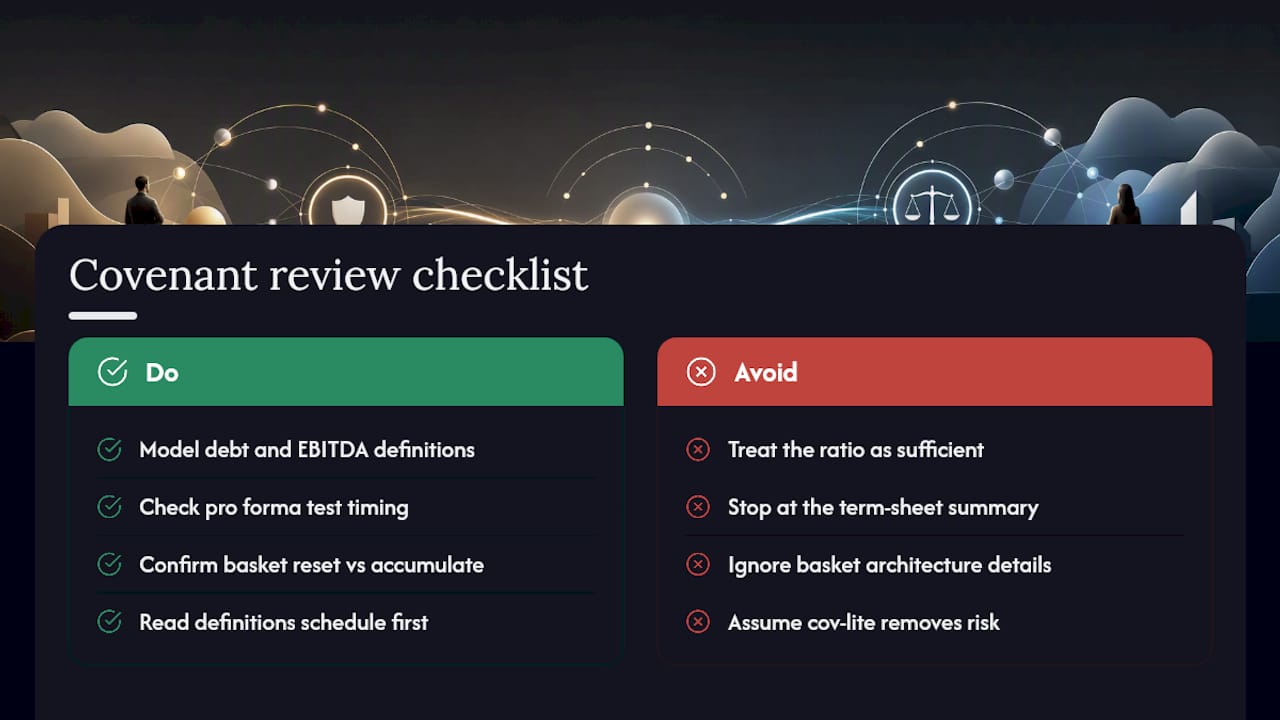
The conventional advice, read the ratio, check the threshold, move on, ignores where covenants actually get won or lost: in the definitions of debt and EBITDA, in the timing of pro forma tests, and in whether a basket resets or accumulates. A leverage covenant set at 4.5x means almost nothing until you know what counts as debt and what gets added back to earnings.
If there’s one priority for anyone underwriting or negotiating these terms, it’s this: model the definitions before you trust the ratio. The cov-lite trend has made this more urgent, not less, because incurrence-only structures shift more of the real protection into basket architecture that rarely gets the scrutiny it deserves. Read the definitions schedule before the summary term sheet, every time.
— James William Dawes
Sources
- LexisNexis: Incurrence covenant (glossary)
- LegalClarity: Covenants analysis — ratios, tests and compliance rules
- Sidley Austin LLP: Financial covenants in private credit transactions
FAQ
What are the three types of covenants?
Loan agreements typically include affirmative covenants (actions the borrower must take, like maintaining insurance), negative covenants (actions the borrower must avoid), and financial covenants, which split further into maintenance and incurrence tests.
What are examples of incurrence covenants?
Common incurrence covenants restrict incurring additional debt beyond permitted baskets, paying dividends, granting new liens, making investments, and completing acquisitions above a set threshold, each tested only when the borrower proposes that specific action.
What are the two types of covenants in finance?
Within financial covenants specifically, the two core types are maintenance covenants, tested on a recurring schedule, and incurrence covenants, tested only when a specific transaction is proposed.
Why does a maintenance breach count as default even if cashflow is fine?
Maintenance ratios are calculated mechanically from defined figures, so timing mismatches, one-off charges, or accounting adjustments can trip a ratio test even when the business comfortably covers its interest payments in practice.
Can a borrower cure a maintenance covenant breach?
Many facility agreements include an equity cure right, letting sponsors inject cash to retroactively restore compliance, usually capped at a limited number of uses across the life of the loan.
Recommended
Related Topics
Speak to a specialist
Discuss your finance with James directly
Whole-of-market specialist finance — bridging, development, commercial and residential. No call centres, no obligation. James reviews every enquiry personally.
New to specialist finance? How unbiased broker advice works · Deals we have completed
Explore Related Finance