
Published · Updated
negotiating covenant packages processNegotiating covenant packages: a guide for UK developers
By James Dawes, CeMAP, Founder, James William & Co Capital

TL;DR:
- Effective negotiation of covenant packages relies on early legal advice and precise drafting to protect borrower flexibility. Proper preparation, including financial modeling and understanding lender priorities, prevents costly defaults and disputes during the loan term. Building a detailed compliance calendar and negotiating specific contractual language are key to managing project risks proactively.
The negotiating covenant packages process is the single most consequential stage of any UK commercial property finance deal. A covenant package is the set of contractual obligations, restrictions, and financial tests embedded in a facility agreement that governs borrower behaviour throughout the loan term. Get these terms wrong and a lender can call in a loan even when interest payments are current. Get them right and you preserve the operational flexibility needed to deliver a development on time and on budget. James William & Co Capital structures bespoke covenant packages across development finance, commercial mortgages, and mezzanine debt, and the firm’s experience confirms that negotiation outcomes depend almost entirely on preparation and legal precision.
What are the essential components of a covenant package?
A covenant package contains three broad categories of obligation, each with distinct negotiation implications. Understanding all three before you enter any discussion with a lender is non-negotiable.
Financial covenants are the most visible. They include loan-to-value ratios, interest cover ratios, and minimum net worth requirements. Lenders set these thresholds to protect their security position. Borrowers must push back on thresholds that leave no headroom for normal market fluctuation, particularly on LTV covenants where property valuations can shift without any fault on the borrower’s part.
Information covenants require borrowers to deliver regular financial statements, valuations, and project updates within defined timeframes. These are often treated as administrative formalities, but late reporting constitutes a technical default that grants lenders immediate enforcement rights regardless of cashflow status. That risk is frequently underestimated by developers focused on construction milestones.
Events of default clauses define what triggers a lender’s right to accelerate repayment. Material adverse change (MAC) clauses are the most dangerous because they can be drafted broadly enough to give lenders subjective discretion. Narrowing MAC clause language to objective, measurable criteria is one of the most valuable things a borrower can achieve during negotiation.
| Covenant category | Purpose | Key negotiation consideration |
|---|---|---|
| Financial covenants (LTV, ICR) | Protect lender security position | Negotiate realistic thresholds with adequate headroom |
| Information covenants | Maintain lender visibility of project | Agree clear timelines and define acceptable reporting formats |
| MAC clauses | Allow lender to act on material deterioration | Narrow to objective, measurable triggers only |
| Cure rights and standstill periods | Provide borrower remedy time after breach | Push for defined windows, e.g. 30 days, before enforcement |
| Security arrangements | Underpin lender recourse | Limit scope and negotiate liability caps where possible |
Facility agreements set out all of these terms with detailed conditions precedent, affecting project risk from the first day of drawdown. Understanding them thoroughly before signing avoids costly renegotiation later.
What preparation do you need before covenant negotiations begin?
Preparation determines the quality of every covenant negotiation strategy you deploy. Arriving at a lender meeting without financial models and legal advice is the equivalent of exchanging contracts without a survey.

The first step is instructing a solicitor with direct experience in UK commercial property finance. UK commercial property lending is largely unregulated by the FCA, which means contract terms carry exceptional legal weight. There is no regulatory backstop if you sign a facility agreement with onerous covenants. A specialist solicitor can identify restrictive clauses before you sign and propose balanced alternatives.
The second step is financial modelling. Build a detailed cash flow model for the project and stress test it against the lender’s proposed covenant thresholds. If an LTV covenant of 65% leaves you with less than 5% headroom under a base case valuation, that threshold needs to move. Lenders respect borrowers who arrive with data, not just requests.
The third step is understanding the lender’s risk profile. A family office lender has different risk appetite and covenant preferences compared to a high-street bank or a private credit fund. Knowing your lender’s priorities helps you identify where they will flex and where they will not.
- Instruct a solicitor experienced in development finance before heads of terms are agreed
- Build a project-specific cash flow model and test it against proposed covenant thresholds
- Research the lender’s standard covenant package and identify non-standard additions
- Prepare a clear summary of the project’s risk profile, exit strategy, and contingency reserves
- Identify which covenants are deal-critical and which are negotiating positions
Pro Tip: Instruct your solicitor at heads of terms stage, not after. Lenders treat heads of terms as a statement of agreed commercial intent. Challenging a covenant after heads of terms are signed is significantly harder and can damage the relationship before the deal has started.
Step-by-step process to negotiate covenant packages in property finance deals
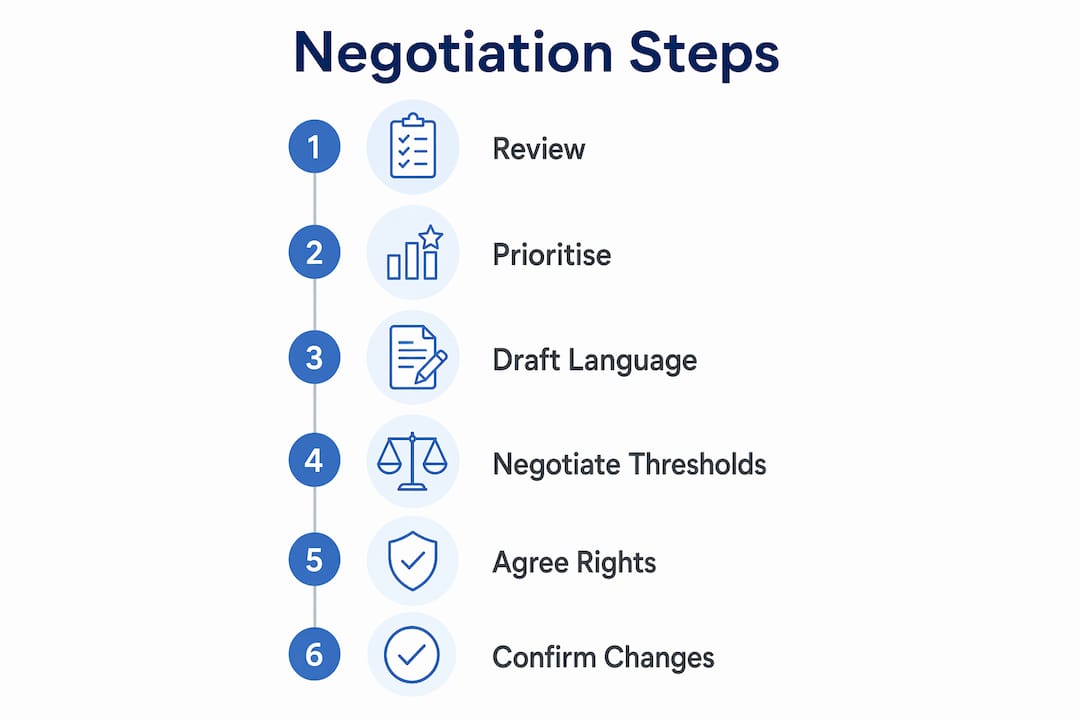
The negotiating covenant packages process follows a logical sequence. Skipping stages creates gaps that surface as disputes during the loan term.
Stage 1: Review and annotate the initial term sheet
Read every covenant in the lender’s initial term sheet and mark each one as acceptable, negotiable, or unacceptable. Do this with your solicitor present. Pay particular attention to financial thresholds, MAC clause language, and any cross-default provisions that link this facility to other borrowings.
Stage 2: Prioritise your negotiating positions
Not every covenant is worth a fight. Rank your priorities clearly. Cure rights and standstill periods for LTV breaches are worth significant effort because defined 30-day cure windows provide vital flexibility to address temporary market fluctuations without triggering default. MAC clause narrowing is equally high priority. Reporting deadlines are lower priority but should still be realistic.
Stage 3: Propose specific, drafted language
Generic requests for “more flexibility” achieve nothing. Covenants are negotiable before signing, and effective negotiation requires clear, balanced drafting with legal assistance. Your solicitor should produce a marked-up version of the facility agreement with precise alternative language for each clause you want to change. Vague requests invite vague responses.
Stage 4: Negotiate thresholds and valuation mechanisms
LTV covenants depend entirely on how the underlying property is valued. Negotiate the valuation methodology, the identity of the approved valuer, and the frequency of revaluations. An objective, pre-agreed valuation mechanism removes the lender’s ability to use a low valuation as a pretext for enforcement.
Stage 5: Agree cure rights and standstill periods
Every financial covenant should carry a defined cure period. A 30-day standstill before a lender can act on an LTV breach gives you time to inject equity, sell an asset, or refinance without the deal collapsing. This is standard in well-negotiated development finance facilities and should be treated as a baseline expectation, not a concession.
Stage 6: Document and confirm all agreed changes
Every agreed change must appear in the final executed facility agreement. Verbal assurances from relationship managers carry no legal weight. Confirm all changes in writing before drawdown.
- Annotate the initial term sheet with your solicitor
- Rank covenant clauses by negotiating priority
- Produce drafted alternative language for each contested clause
- Negotiate thresholds, valuation methods, and MAC clause definitions
- Agree cure rights and standstill periods for each financial covenant
- Confirm all changes in the executed facility agreement before drawdown
Pro Tip: Define every key term in the covenant package explicitly. “Material adverse change” means nothing without a list of what qualifies. Tailored covenant drafting avoids ambiguity, which is the primary source of loan term disputes.
How do you handle common pitfalls in covenant package agreements?
The most dangerous covenant negotiation mistakes are not the ones developers expect. They rarely involve financial covenants. They involve the technical and administrative obligations that developers treat as background noise.
Technical defaults include breaches of information covenants and unauthorised project scope changes. These can grant lenders immediate enforcement rights regardless of cashflow status. A developer who misses a quarterly reporting deadline by two weeks, or who changes a subcontractor without lender consent, can find themselves in default on a performing loan.
Ignoring technical defaults is the most common and most avoidable cause of lender enforcement on performing development loans. Borrowers who monitor only interest payments and LTV ratios miss the full picture. Every information covenant, consent requirement, and reporting obligation carries the same legal weight as a financial threshold. Build a compliance calendar at the start of the loan term and review it monthly.
Personal guarantees and liability caps are a second area where developers consistently accept terms they should challenge. Legal counsel is essential early on to challenge personal guarantees and liability caps, which are often overlooked in the rush to close a deal. A personal guarantee without a defined cap or time limit creates open-ended personal liability that can outlast the project itself.
- Technical default risk: Build a compliance calendar covering every reporting deadline and consent requirement from day one
- Overly broad MAC clauses: Insist on objective, measurable triggers and reject subjective “market conditions” language
- Unlimited personal guarantees: Negotiate a defined cap and a sunset clause tied to LTV or loan repayment milestones
- Timing pressure: Never sign a facility agreement under time pressure without legal review. A missed deadline on a deal is recoverable. A bad covenant package is not
- Lender relationship management: Transparent communication during the loan term reduces the risk of a lender exercising technical rights aggressively
Effective covenant negotiation strategies balance lender protections with borrower operational flexibility to manage project risk proactively. That balance is achievable, but only if you negotiate it before signing.
Key takeaways
Effective covenant package negotiation requires early legal instruction, precise drafted language, and a clear priority ranking of every clause before you engage a lender.
| Point | Details |
|---|---|
| Instruct solicitors early | Challenge restrictive clauses before heads of terms are agreed, not after. |
| Prioritise cure rights | Negotiate defined standstill periods for LTV breaches to prevent enforcement on temporary shortfalls. |
| Narrow MAC clauses | Restrict material adverse change triggers to objective, measurable criteria only. |
| Monitor technical covenants | Build a compliance calendar covering reporting deadlines and consent requirements from day one. |
| Draft with specificity | Tailored covenant language reduces ambiguity and is the primary defence against loan term disputes. |
What I have learned about covenant negotiation in UK property finance
The developers who get the best covenant packages are rarely the ones with the most money or the strongest projects. They are the ones who treat negotiation as a technical discipline rather than a conversation.
I have seen deals where a developer accepted a broadly drafted MAC clause because the relationship manager said “we never enforce that.” Two years later, during a market correction, the lender enforced it. The clause was in the agreement. The verbal assurance was not. That outcome was entirely avoidable.
The most underrated part of the process is the compliance calendar. Developers spend weeks negotiating financial thresholds and then fail to set up a basic system for tracking reporting deadlines. A technical default on a performing loan is embarrassing, expensive, and entirely self-inflicted.
My consistent advice is to treat the covenant package as a live document throughout the loan term, not a box-ticking exercise at drawdown. Markets move. Projects change. Lenders change their internal risk appetite. The borrowers who maintain a clear record of every covenant, every threshold, and every cure right are the ones who manage problems before they become defaults.
The UK commercial property finance market rewards preparation and penalises complacency. The negotiation table is where that preparation pays off.
— James William Dawes
How James William & Co Capital supports covenant package negotiations
James William & Co Capital works with UK property developers, investors, and high-net-worth clients who need more than a standard mortgage broker. The firm acts as a debt structuring partner, managing the full process from initial lender selection through to covenant negotiation and facility execution.
For complex transactions involving multi-layered debt stacks, mezzanine finance, or offshore vehicles, covenant packages require bespoke drafting that reflects the specific risk profile of each deal. James William & Co Capital’s network of family offices, private credit funds, and specialist lenders gives clients access to lenders who understand development risk and will negotiate terms accordingly. If you are working on a large-scale acquisition, ground-up development, or complex refinance in the UK, the team at James William & Co Capital offers specialist property finance in London and across the UK, with a single point of contact for end-to-end structuring and negotiation.
FAQ
What is a covenant package in property finance?
A covenant package is the set of contractual obligations in a facility agreement that governs borrower behaviour, including financial tests, reporting requirements, and events of default. Breaching any covenant, financial or technical, can trigger lender enforcement rights.
When should I start negotiating covenant terms?
Negotiate covenant terms before heads of terms are agreed. Once heads of terms are signed, lenders treat the commercial terms as settled and challenging them becomes significantly harder.
What are cure rights and why do they matter?
Cure rights are defined periods, typically 30 days, during which a borrower can remedy a covenant breach before a lender can enforce. They are particularly valuable for LTV covenants where temporary market movements can cause a technical breach on an otherwise performing loan.
Can all covenants be negotiated?
Covenants are negotiable before a facility agreement is signed. Lenders expect borrowers to propose amendments, and well-drafted alternative language supported by legal counsel is the most effective way to achieve balanced terms.
What is a technical default?
A technical default is a breach of a non-financial covenant, such as a missed reporting deadline or an unauthorised project change. Technical defaults carry the same legal consequences as financial breaches and can trigger enforcement even when interest payments are current.
Recommended
Related Topics
Speak to a specialist
Discuss your finance with James directly
Whole-of-market specialist finance — bridging, development, commercial and residential. No call centres, no obligation. James reviews every enquiry personally.
New to specialist finance? How unbiased broker advice works · Deals we have completed
Explore Related Finance