
Published · Updated
explaining non-recourse lendingNon-recourse lending explained for UK property developers
By James Dawes, CeMAP, Founder, James William & Co Capital

TL;DR:
- Non-recourse lending limits recovery to the collateral asset, with carveouts that can trigger full personal liability. Many developers mistakenly believe it erases personal responsibility, but poorly understood carveouts pose significant risks. Proper legal review and understanding of these clauses are essential to avoid costly mistakes and unintended obligations.
Non-recourse lending is defined as a financing structure where the lender’s recovery rights are limited exclusively to the collateral securing the loan. If the borrower defaults, the lender can seize the property but cannot pursue the borrower’s personal assets, business accounts, or other holdings. For UK real estate investors and property developers, explaining non-recourse lending accurately matters because the term is widely misunderstood. Most developers assume it means zero personal liability. The reality is more nuanced, and getting it wrong can expose you to full personal liability on a loan you believed was ring-fenced.
What is non-recourse lending and how does it work?
Non-recourse lending places the credit risk squarely on the collateral asset rather than the borrower’s personal balance sheet. The lender underwrites the deal based on the asset’s income, value, and exit potential. If the loan fails, the lender’s remedy is enforcement against the property, not a personal guarantee call.

True non-recourse debt is rare in the UK commercial real estate market. Most lenders treat recourse as the default position, and non-recourse requires a deliberate opt-in, typically at a pricing premium. That premium reflects the risk transfer from borrower to lender.
The structure almost always requires the borrowing entity to be a Special Purpose Vehicle. The SPV holds the property, and the lender takes a fixed charge over the asset, a share charge over the SPV, and a debenture covering all assets within it. This security package gives the lender full enforcement control without needing to pursue the borrower personally.
Non-recourse financing options appear most frequently in commercial mortgages, development finance, and institutional lending on income-producing assets such as offices, logistics sheds, and build-to-rent schemes. For a broader view of how these products sit within the UK funding stack, the real estate funding sources guide covers the full range of structures available to UK developers.
What are the ‘bad-boy carveouts’ and why do they matter?
Bad-boy carveouts are the most significant risk factor in any non-recourse loan agreement. They are contractual clauses that convert the loan from non-recourse to full personal recourse upon specific trigger events caused by borrower misconduct or negligence.
The eight standard carveouts seen across institutional non-recourse loans include:
- Fraud or material misrepresentation in the loan application or ongoing reporting
- Environmental damage caused or permitted by the borrower on the secured property
- Unauthorised transfer of the property or SPV ownership without lender consent
- Voluntary bankruptcy filing by the borrower or SPV
- Unpermitted subordinate financing, such as adding mezzanine debt without approval
- Misappropriation of rents or insurance proceeds that should flow to the lender
- Failure to maintain insurance on the secured asset
- Wilful destruction or physical waste of the collateral
Two distinct liability mechanisms apply. Springing recourse triggers full personal liability for the entire loan balance the moment a carveout event occurs. Loss-only recourse limits personal liability to the lender’s actual losses from the specific breach. Springing recourse is the more aggressive and more common formulation in UK institutional lending.
Carveouts exist because lenders accept the risk of market movements but not the risk of borrower misbehaviour. A developer who files voluntary bankruptcy to delay enforcement, for example, removes the lender’s primary remedy. The carveout restores it.
Pro Tip: Always instruct a specialist finance solicitor to produce a carveout schedule before signing any non-recourse facility. The headline terms rarely tell the full story, and a single overlooked clause can convert a £20 million non-recourse loan into full personal liability overnight.
How does non-recourse lending differ from recourse lending?
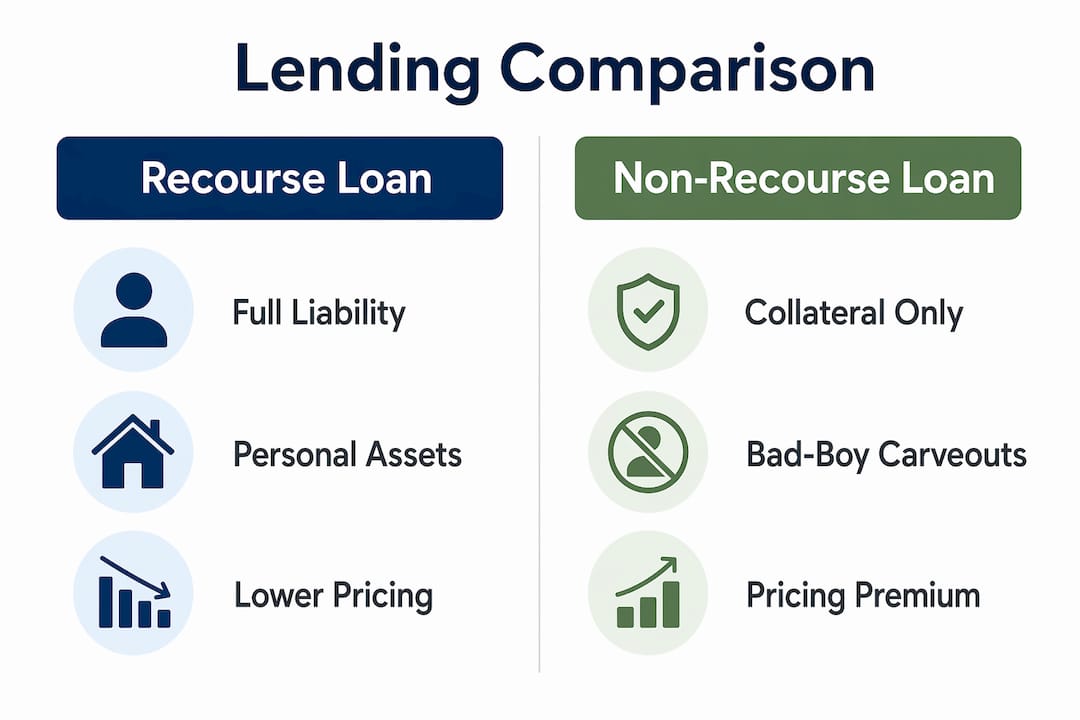
Recourse lending gives the lender the right to pursue the borrower’s personal assets if the collateral fails to cover the outstanding debt. The borrower effectively guarantees the loan with their entire net worth. Non-recourse lending removes that right, subject to the carveout exceptions described above.
The practical difference shows up most clearly at the point of default. In a recourse default, the lender enforces against the property and then pursues a deficiency judgment for any shortfall. In a non-recourse default, the lender takes the property and absorbs any shortfall itself. That risk transfer commands a pricing premium.
Non-recourse loan pricing typically runs 50–75 basis points and 0.25–1.0 points above equivalent recourse facilities, depending on lender, asset class, and loan term. Short-term bridge loans carry the widest premium because execution risk is highest. Long-term agency-style lending on stabilised assets carries the thinnest premium.
| Feature | Recourse loan | Non-recourse loan |
|---|---|---|
| Lender recovery rights | Collateral plus personal assets | Collateral only (subject to carveouts) |
| Borrower liability on default | Full personal liability | Limited to asset value |
| Typical pricing premium | Base rate | 50–75 basis points above recourse |
| SPV requirement | Not always required | Almost always required |
| Personal guarantee | Standard | Replaced by carveout schedule |
| Lender risk appetite | Lower | Higher, reflected in pricing |
Pro Tip: When comparing recourse and non-recourse facilities, model the all-in cost difference against your worst-case exit scenario. If a market correction could leave the asset worth less than the loan, the non-recourse premium often pays for itself.
What role do alternative lenders play in the UK non-recourse market?
Alternative lenders now dominate a significant portion of UK commercial real estate finance. New lending for UK commercial real estate reached £52.7 billion in 2025, a 29% year-on-year increase, with debt fund market share growing from 12% to 28% in that year alone. That shift fundamentally changes how non-recourse loans are structured and negotiated.
Traditional banks apply uniform underwriting standards. Debt funds, insurance companies, and private credit funds underwrite each deal on its specific risk profile. That bespoke underwriting approach creates more room to negotiate non-recourse terms, but it also demands a higher standard of documentation and financial transparency from the borrower.
For developers, this means the quality of your information pack, your SPV structure, and your covenant compliance record all carry more weight than they would with a high-street bank. Alternative lenders set their own benchmarks. A deal that a bank would decline on policy grounds may be fundable with a debt fund at the right price. The current UK property finance trends reflect this growing appetite for complex, bespoke non-recourse structures across development and investment assets.
The implication for borrowers is clear. Engaging a specialist adviser who has direct relationships with these lenders is no longer optional. It is the difference between accessing the market and being priced out of it.
What practical steps should developers take when negotiating non-recourse terms?
Negotiating a non-recourse facility requires preparation that goes well beyond agreeing a headline rate. The following steps reflect what experienced developers and their advisers do before and during the process.
- Instruct specialist legal and finance advisers early. The carveout schedule is a legal document with significant financial consequences. A solicitor experienced in structured property finance should review every clause before heads of terms are signed.
- Keep the SPV clean. The borrowing entity must hold only the secured asset, with no extraneous liabilities, intercompany loans, or undisclosed obligations. SPV cleanliness is foundational to maintaining non-recourse status throughout the loan term.
- Understand every covenant. Loan covenants on non-recourse facilities typically cover insurance maintenance, rent collection procedures, permitted alterations, and reporting obligations. Breaching any of these can trigger a carveout event.
- Negotiate recourse burn-off provisions where possible. Some lenders will agree to reduce or eliminate personal liability after a defined period of satisfactory performance. This provision is worth pushing for, particularly on development loans where risk reduces as the scheme completes.
- Model the cost-benefit trade-off explicitly. The premium on a non-recourse facility is real money. Set it against the value of the personal liability protection and the probability of a default scenario before committing.
- Maintain proactive lender communication. Alternative lenders respond well to transparency. Keeping your lender informed of project progress, delays, and changes reduces the risk of technical covenant breaches that could trigger carveout events.
Pro Tip: Ask your lender for a written confirmation of what constitutes a carveout trigger event under your specific facility. Verbal assurances carry no weight at enforcement. Get it in the loan agreement, not in an email.
Reviewing how to optimise your real estate funding structure before approaching lenders will also strengthen your negotiating position considerably.
What are the tax and financial consequences of non-recourse defaults?
The tax treatment of a non-recourse default differs materially from a recourse default, and the distinction has a direct impact on your personal financial position.
In a non-recourse foreclosure, HMRC treats the transaction as a deemed sale of the property at the outstanding loan balance. The borrower recognises a capital gain or capital loss based on the difference between that deemed sale price and the original acquisition cost. No income tax charge arises on the debt itself because the borrower never had an obligation to repay beyond the asset.
In a recourse default, the lender may pursue a deficiency judgment and ultimately agree to forgive the remaining debt. That forgiven amount can be treated as a taxable receipt, potentially subject to income tax rather than capital gains tax. The distinction matters because income tax rates are higher than capital gains tax rates for most property investors.
The tax consequence of a non-recourse default is often more favourable than a recourse default, but the outcome depends entirely on the specific loan terms, the borrower’s tax position, and how the enforcement is structured. Professional tax advice before signing any non-recourse facility is not optional. It is a financial necessity.
Key financial considerations when evaluating non-recourse structures include:
- Capital gains treatment on deemed sale at loan balance in a non-recourse foreclosure
- Income tax exposure on forgiven debt in recourse default scenarios
- Impact on personal net worth if carveout events convert the loan to full recourse
- Interaction with offshore holding structures and the tax implications of SPVs held through non-UK entities
The risk transfer mechanisms inherent in non-recourse structures also interact with insurance obligations, which adds another layer of professional advice required before committing to a facility.
Key takeaways
Non-recourse lending limits lender recovery to the collateral asset, but bad-boy carveouts, pricing premiums, and SPV compliance requirements mean the protection is conditional, not absolute.
| Point | Details |
|---|---|
| Core definition | The lender can only recover from the collateral asset, not the borrower’s personal assets. |
| Carveout risk | Fraud, voluntary bankruptcy, and unauthorised transfers trigger full personal liability instantly. |
| Pricing premium | Non-recourse facilities typically cost 50–75 basis points more than equivalent recourse loans. |
| SPV requirement | A clean Special Purpose Vehicle is mandatory for most non-recourse structures in the UK. |
| Tax treatment | Non-recourse default is treated as a deemed property sale, not taxable debt forgiveness. |
The misconception that costs developers most
Most developers I speak with come to non-recourse lending with the same assumption: that the structure means they cannot be personally liable. That assumption is wrong, and acting on it without reading the carveout schedule is one of the most expensive mistakes in UK property finance.
The carveout clauses are not boilerplate. They are the lender’s primary protection against borrower misconduct, and they are drafted to be triggered easily. Voluntary bankruptcy is the most common example. A developer facing a difficult project files for insolvency to buy time, not realising that this single act converts a £15 million non-recourse loan into a full personal liability claim. The lender’s lawyers are ready for it. The developer’s usually are not.
The growth of alternative lenders has made non-recourse financing more accessible than it was five years ago. Debt funds will structure deals that banks would not touch. But that flexibility comes with more complex documentation, tighter covenants, and less standardised carveout language. The deals are better, but the contracts require more scrutiny, not less.
My consistent advice is to treat the carveout schedule with the same seriousness as the loan-to-value ratio. The headline rate tells you what the loan costs. The carveout schedule tells you what the loan actually is.
— James William Dawes
Specialist property finance with James William & Co Capital
James William & Co Capital works with UK property developers and investors who need non-recourse structures arranged correctly from the outset. The firm’s relationships with debt funds, private credit funds, and specialist lenders give clients direct access to the lenders most active in non-recourse commercial real estate finance.
James William & Co Capital structures the full debt stack, reviews carveout schedules alongside specialist legal counsel, and negotiates terms that reflect the specific risk profile of each project. For developers working on large-scale acquisitions, ground-up schemes, or complex refinances, the firm acts as a single point of contact from initial structuring through to drawdown. Contact James William & Co Capital through the specialist property finance page to discuss your next transaction.
FAQ
What is non-recourse lending in simple terms?
Non-recourse lending is a loan where the lender can only recover money by seizing the collateral asset. The borrower’s personal assets are protected if the property value falls short of the outstanding debt.
What triggers personal liability on a non-recourse loan?
Bad-boy carveout events such as fraud, voluntary bankruptcy, unauthorised property transfer, and unpermitted subordinate financing convert the loan to full personal recourse immediately upon occurrence.
How much more does a non-recourse loan cost than a recourse loan?
Non-recourse facilities typically carry a pricing premium of 50–75 basis points and 0.25–1.0 points above equivalent recourse loans, with the widest premiums on short-term bridge and value-add transactions.
Do I need an SPV to get a non-recourse loan in the UK?
Yes. Lenders require a clean Special Purpose Vehicle to hold the secured asset, with a fixed charge, share charge, and debenture forming the security package that enables enforcement without personal recourse.
How is a non-recourse default taxed in the UK?
A non-recourse foreclosure is treated as a deemed sale of the property at the outstanding loan balance, generating a capital gain or loss rather than taxable income. Professional tax advice is required to assess the specific outcome for your position.
Recommended
Related Topics
Speak to a specialist
Discuss your finance with James directly
Whole-of-market specialist finance — bridging, development, commercial and residential. No call centres, no obligation. James reviews every enquiry personally.
New to specialist finance? How unbiased broker advice works · Deals we have completed
Explore Related Finance