
Published · Updated
role of high net worth investorsRole of high net worth investors in UK finance
By James Dawes, CeMAP, Founder, James William & Co Capital

TL;DR:
- High net worth investors shape UK financial markets by providing liquidity and influencing deal structures. They prioritize wealth preservation through bespoke strategies, private markets, and risk management, while actively supporting economic growth. Coordinated advice and private market participation are essential for their effective wealth management and sustained industry impact.
High net worth investors are defined by the Financial Conduct Authority as individuals with annual income exceeding £100,000 or net assets above £250,000, and they represent one of the most consequential forces in UK financial markets. The role of high net worth investors extends far beyond personal wealth accumulation. These investors provide critical liquidity to private markets, shape deal structures in property and private equity, and influence the depth of government funding. Understanding their strategies and influence matters whether you are an adviser, developer, or institutional partner seeking to work alongside serious capital.
How do high net worth investors shape portfolio strategies?
UK high net worth investors prioritise wealth preservation, income generation, and intergenerational transfer above all else. This distinguishes them sharply from retail investors, who typically focus on growth through listed equities and cash savings. The wealth management approach of HNWIs involves bespoke lending, offshore vehicles, and structures that retail products simply cannot replicate. The objective is not just to grow capital but to protect it across generations.
Portfolio construction at this level rejects the traditional 60/40 equity-to-bond split. Private markets now function as a core portfolio pillar rather than a peripheral allocation. 82% of UK HNWIs cite income generation as their primary investment objective. That shift has driven capital away from trophy assets and towards income-producing real estate such as purpose-built student accommodation and commercial property.
Concentrated positions in founder-owned businesses are common among this cohort. Unlike retail investors, HNWIs frequently hold significant stakes in their own companies and must manage the resulting concentration risk deliberately. Diversification happens through gradual sales, sequenced disposals timed to use available tax reliefs, and hedging strategies rather than simple rebalancing.
- Wealth preservation takes precedence over pure growth, with structures designed to protect capital across market cycles.
- Alternative asset allocations are substantial, covering private equity, private credit, infrastructure, and real assets.
- Bespoke lending and offshore vehicles provide structural efficiency unavailable through standard retail products.
- Active risk management includes hedging, sequenced disposals, and use of Business Asset Disposal Relief.
- Intergenerational transfer shapes every major portfolio decision, from trust structures to succession planning.
Pro Tip: If you are advising a high net worth client who holds a concentrated founder position, sequence disposals across tax years to maximise Business Asset Disposal Relief and reduce capital gains exposure in any single period.
What is the role of high net worth investors in private markets?
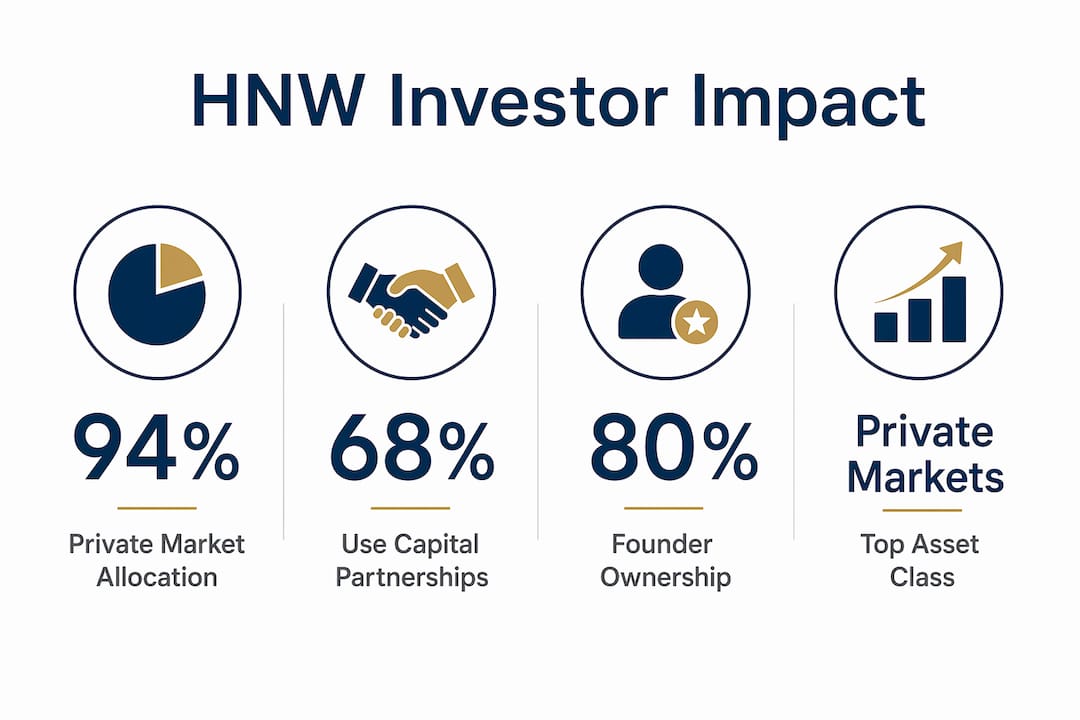
Private markets have become the defining arena for high net worth capital. 94% of HNW investors globally and in the UK now allocate capital to private markets, making it the second largest portfolio pillar after public equities. That figure surpasses many institutional benchmarks and signals a structural shift rather than a cyclical trend.

The reason is straightforward. Companies remain private for longer, meaning the most significant growth phase now occurs before any public listing. Investors who restrict themselves to public markets miss the period of highest value creation. Private markets exposure has therefore become a prerequisite for long-term performance, not an optional enhancement.
| Asset class | Typical HNWI allocation approach | Primary objective |
|---|---|---|
| Private equity | Direct investments and investment trusts | Capital growth and early-stage value capture |
| Private credit | Specialist platforms and direct lending funds | Income generation and yield premium |
| Infrastructure | Long-duration funds and co-investments | Inflation protection and stable income |
| Real estate | Direct ownership and debt structures | Income generation and capital preservation |
| Public equities | Core listed holdings | Liquidity and benchmark exposure |
Private company equity now exceeds bonds and cash in many HNWI portfolios. Private credit and infrastructure have grown particularly quickly as investors seek yield without the volatility of public markets. Access methods range from direct investments and co-investments to specialist platforms and investment trusts, depending on deal size and required governance.
Pro Tip: For HNW investors entering private credit for the first time, specialist platforms that offer co-investment alongside established managers provide both access and due diligence support without requiring a full direct lending capability.
Advisers and wealth managers working with this cohort must understand that private market allocations require longer time horizons, illiquidity tolerance, and deeper due diligence. The real estate debt structures that underpin many private market transactions are increasingly sophisticated, involving mezzanine layers, preferred equity, and bespoke covenant packages.
How do high net worth investors influence UK economic growth?
The economic impact of wealthy investors in the UK is substantial and underappreciated by government. HNW and foreign portfolio investors are critical to UK market depth and government funding, yet they lack systematic tracking or targeted promotion compared to foreign direct investment. That gap represents a significant policy failure given the scale of capital involved.
The proposed British Business investment visa illustrates the potential. Targeting 100 successful applicants per year, the scheme carries an estimated £900m economic impact and supports roughly 4,000 jobs through capital investment in high-growth sectors. That is a meaningful return from a relatively small cohort of investors. The implication is clear: targeted engagement with HNW capital produces outsized economic results.
The risks of neglecting this cohort are equally significant. Up to £100 billion of assets could relocate from the UK due to tax uncertainty and concerns about new wealth taxes. Capital flight at that scale would reduce market depth, increase government borrowing costs, and reduce private sector investment in property and growth businesses.
- Market liquidity depends on HNW capital flowing through private placements, property transactions, and secondary market activity.
- Government funding benefits from HNWI participation in gilt markets and structured investment vehicles.
- Job creation follows from capital deployment into high-growth sectors, as the British Business investment visa projections confirm.
- Capital-intensive sectors such as property development rely on HNW co-investment and joint ventures to reach viable deal sizes.
68% of investors consider joint ventures or capital partnerships to access specialist expertise, diversify, and engage in capital-intensive sectors. That figure reflects how HNW investors function as genuine economic partners rather than passive capital providers. Understanding property finance trends in 2026 requires understanding where this capital is flowing and why.
What wealth management techniques do HNW investors use?
Sophisticated wealth management at the high net worth level involves coordinated advisory teams rather than a single relationship manager. Private banks, family offices, specialist tax advisers, and discretionary fund managers each play a distinct role. The challenge is coordination. Without an integrated framework, conflicting advice across these relationships destroys value.
The distinction between ultra high net worth (UHNW), very high net worth (VHNW), and general HNW investors matters here. UHNW individuals with assets above £30m typically operate through dedicated family offices with in-house investment and legal teams. VHNW investors with assets between £5m and £30m often use a combination of private banking and specialist advisers. General HNW investors below that threshold rely more heavily on discretionary managers and specialist brokers.
- Family offices provide consolidated oversight of investment, tax, legal, and succession planning for UHNW clients.
- Private banks offer discretionary management, lending against portfolios, and access to private placements.
- Specialist advisers handle tax efficiency, Business Asset Disposal Relief sequencing, and offshore structuring.
- Discretionary managers execute portfolio strategy within agreed parameters, providing day-to-day management.
- Specialist brokers such as James William & Co Capital structure complex property finance, mezzanine debt, and JV equity for capital-intensive transactions.
Legacy holdings present a recurring challenge. A founder who has built a business over 30 years may hold 80% of their net worth in a single illiquid asset. Managing the transition from that concentrated position to a diversified portfolio requires careful sequencing, tax planning, and often a phased approach to liquidity events. The real estate funding strategies that accompany these transitions frequently involve bridging finance, development debt, and structured refinancing.
Key takeaways
High net worth investors are the primary drivers of private market growth in the UK, and their capital decisions shape everything from property development pipelines to government funding costs.
| Point | Details |
|---|---|
| Private markets are now core | 94% of HNW investors allocate to private markets, making it the second largest portfolio pillar after public equities. |
| Income generation leads strategy | 82% of UK HNWIs prioritise income over capital growth, shifting capital towards real assets and private credit. |
| Economic impact is underestimated | £900m in projected economic impact from just 100 investment visa holders shows the outsized return from targeted HNW engagement. |
| Capital flight is a real risk | Up to £100 billion of HNWI assets could leave the UK due to tax uncertainty, with direct consequences for market depth. |
| Coordinated advice is non-negotiable | HNW investors require integrated teams across private banking, tax, legal, and specialist finance to protect and grow wealth effectively. |
The private market shift is permanent, not cyclical
I have spent years working alongside developers, family offices, and institutional investors on complex UK property transactions, and the most significant change I have observed is not a trend. It is a structural reset. Private markets are no longer the preserve of endowments and sovereign wealth funds. They are where serious individual capital now lives.
What strikes me most is how poorly served many HNW investors still are when it comes to execution. The advisory framework exists. The appetite for private credit, development finance, and JV equity is genuine. But the gap between strategy and deal completion remains wide for too many clients. Coordination failures between tax advisers, wealth managers, and finance brokers cost investors real money and real time.
The wealth transfer wave coming over the next decade will accelerate this. As UHNW founders pass assets to the next generation, the recipients will be less attached to legacy structures and more willing to deploy capital into private markets, real assets, and structured finance. Advisers who understand both the investment rationale and the execution mechanics will be indispensable. Those who only understand one side will struggle to remain relevant.
— James William Dawes
Specialist property finance for high net worth investors
James William & Co Capital works directly with high net worth investors, developers, and family offices on the complex transactions that standard lenders cannot structure. From mezzanine debt and JV equity to multi-layered development finance and commercial refinancing, the firm acts as a single point of contact for end-to-end execution.

For HNW investors deploying capital into UK real estate, the quality of debt structuring determines whether a transaction completes at the right price and on the right terms. James William & Co Capital’s specialist property finance solutions are built for exactly this cohort, combining access to private credit funds, family offices, and specialist lenders with the speed and precision that high-value transactions demand. Speak to the team about your next acquisition, development, or refinancing requirement.
FAQ
What defines a high net worth investor in the UK?
The Financial Conduct Authority defines a high net worth individual as someone with annual income above £100,000 or net assets exceeding £250,000. This classification determines access to certain investment products and regulatory protections.
Why do high net worth investors favour private markets?
94% of HNW investors now allocate to private markets because companies remain private longer, meaning the highest growth phase occurs before any public listing. Restricting capital to public markets means missing the period of greatest value creation.
What is the economic impact of high net worth investors in the UK?
HNW investors contribute to market liquidity, government funding, and job creation at scale. The proposed British Business investment visa alone projects a £900m economic impact and 4,000 jobs from just 100 investors per year.
How do high net worth investors manage concentration risk?
UK HNWIs with concentrated founder positions use gradual sales and hedging alongside sequenced disposals timed to maximise Business Asset Disposal Relief. This approach reduces tax exposure while systematically diversifying the portfolio.
What role do joint ventures play in high net worth investment strategies?
Joint ventures allow HNW investors to access capital-intensive sectors that exceed individual investment limits. 68% of investors consider partnerships to secure specialist expertise, diversify risk, and participate in larger transactions.
Recommended
Related Topics
Speak to a specialist
Discuss your finance with James directly
Whole-of-market specialist finance — bridging, development, commercial and residential. No call centres, no obligation. James reviews every enquiry personally.
New to specialist finance? How unbiased broker advice works · Deals we have completed
Explore Related Finance