
Published
what is corporate guaranteeCorporate guarantee explained: a practical guide for directors
By James Dawes, CeMAP, Founder, James William & Co Capital

A corporate guarantee is a legally binding promise by one company (the guarantor) to meet the financial obligations of another company (the principal debtor) if that debtor defaults, with the lender or counterparty (the beneficiary) holding the right to enforce directly against the guarantor’s corporate assets. The guarantor’s balance sheet is what is at risk, not an individual’s personal wealth.
Three quick distinctions to frame everything that follows:
- Corporate guarantee vs personal guarantee: a corporate guarantee exposes the guarantor company’s assets; a personal guarantee exposes an individual director’s or owner’s personal assets, including their home and savings.
- Corporate guarantee vs indemnity: a guarantee is a secondary obligation, triggered only when the principal debtor actually defaults; an indemnity is a primary obligation, meaning the indemnifier can be called upon immediately, independent of the debtor’s position.
- UK vs Australia: both jurisdictions share the same common-law foundation for guarantees, but differ on the detail of directors’ duties and insolvency rules. Those country-specific differences are covered fully in Section 5.
A corporate guarantee attaches liability to the guarantor company’s balance sheet. If the guarantee is called and the guarantor cannot pay, the consequences can cascade through an entire corporate group — not just the entity that signed.
Key takeaways
A corporate guarantee binds the guarantor company’s entire balance sheet to another entity’s obligations, and the legal, commercial, and director-duty consequences demand proper process before any signature is given.
| Point | Details |
|---|---|
| Definition and parties | A corporate guarantee is a secondary obligation binding the guarantor company to the beneficiary if the principal debtor defaults. |
| Guarantee vs indemnity | An indemnity is a primary obligation; a guarantor under a demand guarantee can face immediate liability without proof of the debtor’s default. |
| Directors’ duties | UK directors must record commercial benefit and pass a board resolution; Australian directors face parallel duties plus insolvent-trading risk. |
| Key negotiation levers | Cap the amount, limit scope to a named facility, set a sunset clause, and define release events before signing. |
| Upstream guarantee risk | A subsidiary guaranteeing its parent with no consideration risks unlawful distribution and transaction-at-undervalue challenge in insolvency. |
Table of Contents
- What is a corporate guarantee and how does it work in practice?
- How does a corporate guarantee differ from a personal guarantee, a bank guarantee and an indemnity?
- Common types of corporate guarantees and the wording to watch
- Legal implications for directors in the UK and Australia
- How enforcement works when a guarantee is called
- Risks for guarantor companies and their directors
- Practical negotiation checklist for property and development finance
- What to do if you are asked to sign a corporate guarantee
- Worked example: an upstream guarantee and what can go wrong
- The part most directors get wrong
- Sources
- FAQ
What is a corporate guarantee and how does it work in practice?
A corporate guarantee is a contractual promise where one company undertakes to answer for another company’s obligations to a third party. The legal structure is tripartite: the guarantor company, the principal debtor (the company whose obligations are being guaranteed), and the beneficiary (typically a lender, landlord, or counterparty). The guarantee only becomes active when the principal debtor fails to perform.
Common commercial contexts where guarantees appear include:
- A parent company guaranteeing a subsidiary’s loan from a bank or private credit fund
- A developer’s holding company guaranteeing a special purpose vehicle’s (SPV) development finance facility
- A tenant’s parent company guaranteeing lease obligations to a landlord
- A subsidiary guaranteeing obligations under a syndicated facility where the borrower is another group entity
A brief example: Suppose a property development SPV borrows £8 million from a lender to fund a ground-up residential scheme. The SPV has limited assets of its own. The lender requires the SPV’s parent holding company to provide a corporate guarantee. If the SPV defaults on interest payments, the lender can demand payment directly from the holding company under the guarantee, without first exhausting remedies against the SPV.
That scenario is routine in UK property development finance. What catches directors off guard is the breadth of what they have agreed to guarantee.
Pro Tip: When reviewing a draft guarantee, look immediately for the words “all monies”, “continuing” and “primary obligor”. Each of those phrases materially widens the guarantor’s exposure beyond what most directors assume they are signing.
How does a corporate guarantee differ from a personal guarantee, a bank guarantee and an indemnity?
The differences are not just technical. They determine who pays, when they pay, and what defences are available.
Corporate guarantee vs personal guarantee
| Feature | Corporate guarantee | Personal guarantee |
|---|---|---|
| Who signs | A company (by authorised directors) | An individual (director, shareholder, or owner) |
| Assets at risk | The guarantor company’s corporate assets | The individual’s personal assets (home, savings, investments) |
| Enforcement route | Against the company’s balance sheet | Against the individual personally |
| Typical context | Parent/subsidiary, group finance, leases | SME lending, limited-trading-history borrowers |
Lenders seek personal guarantees where the borrowing company has limited trading history or weak credit, because a corporate guarantor with thin assets offers little real comfort. Both types can sit alongside each other in the same transaction.
See-to-it guarantee vs indemnity: why the distinction matters
English law draws a sharp line between a see-to-it (true) guarantee and an indemnity or demand guarantee.
- See-to-it guarantee: secondary liability. The guarantor is only obliged to perform if the principal debtor has actually defaulted. Defences available to the debtor (such as variation of the underlying contract without consent) can discharge the guarantor.
- Indemnity/demand guarantee: primary liability. The indemnifier’s obligation is independent of the debtor’s position. A compliant demand triggers payment, regardless of whether the debtor has a valid defence. Lenders often include both in the same document precisely to close off guarantor defences.
The practical consequence: a guarantor who believes they have signed a “guarantee” may actually face immediate liability under an indemnity clause embedded in the same document. That is not a drafting quirk. It is a deliberate lender mechanic.
Is a corporate guarantee the same as a bank guarantee? No. A bank guarantee is issued by a financial institution on behalf of a client, typically as a standalone instrument (often a demand guarantee or standby letter of credit). A corporate guarantee is issued by a company, not a bank, and is usually a contractual document within a wider finance or lease agreement.
Common types of corporate guarantees and the wording to watch
Knowing the label on a guarantee is less important than knowing what the operative clauses actually say. These are the types you will encounter most often, and the specific language that changes your exposure.
-
All-monies guarantee: covers all present and future obligations owed by the principal debtor to the beneficiary under any facility, not just the specific loan in front of you. Practitioners consistently flag this as the most common negotiation failure: directors sign an all-monies guarantee thinking it covers one facility, only to find it extends to future drawdowns, amendments, and even unrelated facilities with the same lender.
-
Continuing guarantee: remains in force until formally discharged, regardless of repayments or partial satisfaction. The phrase “until all obligations are fully and finally discharged” is the tell. Without a sunset clause or defined release event, the guarantee runs indefinitely.
-
Limited or capped guarantee: restricts the guarantor’s liability to a specified amount (for example, £2 million or 25% of the facility). This is the outcome to negotiate for. Always confirm whether the cap includes or excludes interest, costs, and enforcement expenses.
-
Unconditional guarantee: the guarantor waives most defences, including those arising from variation of the underlying agreement. Combined with an indemnity clause, this is the most aggressive form a lender can request.
-
Demand guarantee: payment is due on a compliant written demand, without proof of default by the principal debtor. Strict compliance with demand conditions is critical; minor technical failures in the demand can be a defence, though courts apply this narrowly.
-
Upstream guarantee: a subsidiary guarantees its parent’s obligations. This raises specific director duty and solvency concerns (covered in detail in Section 5 and the worked example in Section 10).
-
Downstream guarantee: a parent guarantees a subsidiary’s obligations. The more commercially intuitive direction, but still requires proper board process and documentation of benefit.
Negotiation tips by type:
- All-monies: push for limitation to a named facility and defined maximum amount.
- Continuing: insist on a defined expiry date or automatic release on repayment of the specified facility.
- Unconditional: seek reinstatement of standard guarantor defences, particularly the right to be notified of material amendments.
- Demand guarantee: require that demand conditions are precisely defined and that the fraud exception is acknowledged in writing.
Pro Tip: A “limited guarantee” that caps principal but not interest and costs can still expose the guarantor to a sum well above the headline cap. Always define what the cap covers, in writing, before signing.
Legal implications for directors in the UK and Australia
UK: Companies Act 2006 and directors’ duties
Before a UK company enters a guarantee, its directors must satisfy themselves that doing so is in the company’s interests. Section 172 of the Companies Act 2006 requires every director to act in the way they consider, in good faith, most likely to promote the success of the company for the benefit of its members. Entering a guarantee that provides no commercial benefit to the guarantor company is a breach of that duty.
Practical requirements before signing:
- Hold a formal board meeting and pass a resolution authorising the guarantee
- Minute the commercial benefit to the guarantor company (not just the group)
- Check the company’s articles of association for any restrictions on giving guarantees
- Obtain independent legal advice, particularly for upstream or cross-stream guarantees
- Run a solvency check: can the company meet its obligations if the guarantee is called?
The GOV.UK guidance on directors’ duties is explicit that directors must consider the interests of the company itself, not merely the group. A guarantee that benefits the parent but strains the subsidiary’s balance sheet is precisely the scenario that attracts scrutiny.
Australia: parallel duties and insolvency risk
Australian directors face equivalent obligations under the Corporations Act 2001 (Cth). The duty to act in the best interests of the company (section 181) and the prohibition on insolvent trading (section 588G) are the two most relevant provisions. Entering a guarantee that renders the company unable to pay its debts as they fall due can expose directors to personal liability for insolvent trading, a risk that is distinct from the UK position.
Australian courts have also shown willingness to set aside guarantees given by subsidiaries for parent obligations where no genuine commercial benefit was demonstrated, treating them as uncommercial transactions under the Corporations Act.
Boards in both jurisdictions should treat commercial benefit as a substantive question, not a box-ticking exercise. A one-line minute saying “the board considered the commercial benefit” without recording what that benefit is will not withstand scrutiny in insolvency proceedings.
Insolvency traps in both jurisdictions
A guarantee can be set aside as a transaction at undervalue (UK: Insolvency Act 1986, s.238; Australia: Corporations Act, s.588FB) if the guarantor received no or inadequate consideration. If the guarantor subsequently enters insolvency, a liquidator will examine every guarantee given in the preceding two years (or longer if connected parties are involved) and may seek to void it. That does not eliminate the lender’s claim; it simply removes the guarantee as a source of recovery, which can complicate the whole group’s position.
Pro Tip: Before any board approves a guarantee, the company secretary should prepare a written solvency statement, obtain a copy of the latest management accounts, and confirm that the guarantee does not breach any existing loan covenants. These three steps take hours; fixing the consequences of skipping them can take years.
How enforcement works when a guarantee is called
When a principal debtor defaults, the sequence of events typically runs as follows:
- Default and notice: the lender issues a formal default notice to the principal debtor, specifying the breach and any cure period.
- Demand under the guarantee: once the cure period expires (or immediately, for a demand guarantee), the lender serves a written demand on the guarantor. The demand must comply with any formal requirements in the guarantee document.
- Enforcement of security: the lender may simultaneously enforce any security it holds (charges, mortgages, debentures) over the debtor’s or guarantor’s assets.
- Litigation or insolvency proceedings: if the guarantor does not pay, the lender can issue proceedings for a debt claim or, where the sum is undisputed, petition for the guarantor’s winding up.
For a see-to-it guarantee, the guarantor can raise defences available to the principal debtor, including that the underlying debt has been varied without consent, that the debt has been discharged, or that the lender has released security. For a demand guarantee or indemnity, those defences largely fall away. Payment is due on a compliant demand, and the only recognised defence under English law is fraud — a high bar that courts apply narrowly.
If you are served with a demand, act immediately:
- Identify whether the instrument is a true guarantee or an indemnity/demand guarantee
- Check that the demand strictly complies with the document’s formal requirements (amount, addressee, signature, timing)
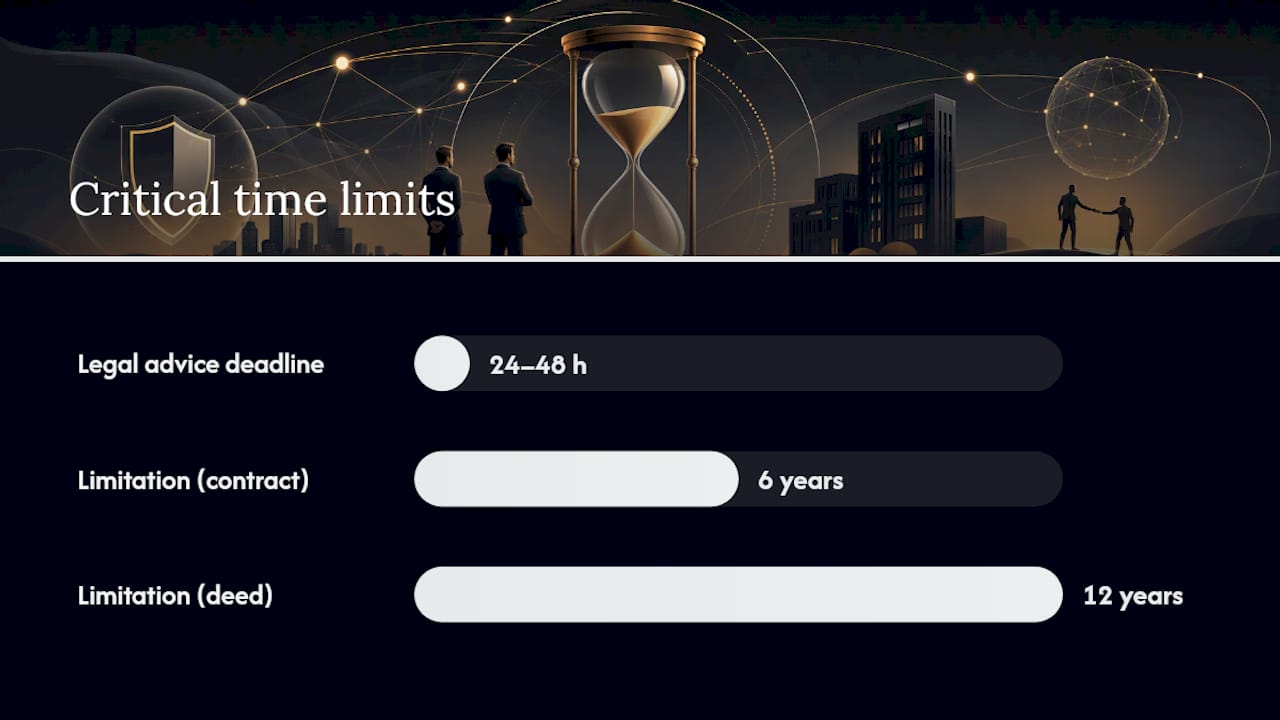
- Obtain legal advice within 24–48 hours, particularly if an injunction to restrain payment may be available
- Preserve all records relating to the underlying transaction and the guarantee
- Open a dialogue with the lender: negotiated settlements are common and often preferable to litigation
Time limits matter. Limitation periods for guarantee claims are six years from the date of breach under English law (12 years if the guarantee is executed as a deed). Missing a procedural deadline can forfeit a valid defence.
Risks for guarantor companies and their directors
Corporate risks
- Balance-sheet strain: a contingent liability under a guarantee must be disclosed and can affect the guarantor’s own borrowing capacity and covenant compliance
- Insolvency contagion: if the guarantee is called and the guarantor cannot pay, it may itself become insolvent, spreading distress through the group
- Transaction at undervalue: a guarantee given for no consideration can be set aside by a liquidator, creating uncertainty for the lender and reputational damage for the group
- Covenant breach: many existing loan agreements prohibit a borrower from giving guarantees without lender consent; signing without checking triggers a cross-default
Director risks
- Breach of duty under Companies Act 2006 s.172 (UK) or Corporations Act 2001 s.181 (Australia) if commercial benefit is not genuine and documented
- Personal liability for insolvent trading (Australia) if the guarantee tips the company into insolvency
- Disqualification proceedings in the UK if a director’s conduct in relation to a guarantee is found to be unfit
The ‘corporate’ label on a guarantee does not insulate the group from cascading failure. A guarantee called against a guarantor with thin reserves can collapse the guarantor, trigger cross-defaults in its own facilities, and bring down solvent entities that happen to share banking relationships with the distressed group.
For property developers using layered structured finance, this cascade risk is particularly acute. A guarantee given by a holding company across multiple SPVs can create simultaneous exposure across an entire portfolio if one scheme hits difficulty.
Practical negotiation checklist for property and development finance
Advisers working in development finance approach guarantee negotiation systematically. The following checklist reflects standard practice.
- Cap the amount: negotiate a defined maximum liability, expressed as a fixed sum, and confirm it includes or excludes interest, costs, and enforcement expenses.
- Limit the scope: restrict the guarantee to a named facility and a specified borrower. Resist all-monies wording.
- Set an expiry: include a sunset clause or automatic release on repayment, practical completion, or refinancing.
- Require consideration: the guarantor should receive something of value, even a nominal intercompany fee or indemnity from the principal debtor, to support enforceability and reduce transaction-at-undervalue risk.
- Obtain board minutes: pass a formal resolution, record the commercial benefit, and attach a solvency statement.
- Insist on independent legal advice: particularly for upstream or cross-stream guarantees.
- Negotiate release events: define the specific events (full repayment, asset sale, refinancing) that automatically discharge the guarantee.
- Check joint and several wording: if multiple guarantors are involved, understand whether liability is joint and several (each guarantor liable for the whole) or proportionate (each liable for a defined share).
- Carve out fraudulent or unrelated amendments: the guarantee should not extend to amendments to the underlying facility made without the guarantor’s consent.
- Consider reciprocal security: in some transactions, the guarantor can negotiate a charge over the principal debtor’s assets as counter-security.
Red flags specific to property finance include: broad all-monies wording covering future facilities, unlimited continuing guarantees with no release mechanism, and guarantees that extend to cost overruns without a defined cap. For bridging finance in particular, where timelines are compressed, lenders sometimes present guarantee documents late in the process. Resist signing under time pressure without legal review.
Pro Tip: Ask the lender for a draft guarantee at heads-of-terms stage, not at completion. Negotiating guarantee terms after credit approval is granted is significantly harder than building limitations into the term sheet from the outset.
What to do if you are asked to sign a corporate guarantee
- Pause before signing. A guarantee is a contingent liability that can survive for years. No lender deadline justifies signing without understanding what you are agreeing to.
- Obtain the full documentation. Request the guarantee document, the underlying facility agreement, and any security documents. The guarantee must be read alongside the facility it supports.
- Run a solvency check. Confirm the guarantor company can meet its existing obligations and could absorb the guarantee liability if called. Use current management accounts, not year-end figures.
- Record the board decision. Hold a formal board meeting, pass a resolution, and minute the commercial benefit. Attach the solvency statement to the minutes.
- Get independent legal advice. This is non-negotiable for upstream guarantees and strongly advisable for any guarantee above a material threshold.
- Negotiate a cap and expiry. Even if the lender resists, put the request on record. A lender’s refusal to cap an all-monies guarantee is itself a material risk signal.
- Agree release events in writing. Define what discharges the guarantee before you sign, not after.
Pro Tip: Involve the CFO, company secretary, and external counsel from the moment a guarantee request arrives. For urgent lender deadlines, prepare a one-page internal checklist: solvency confirmed, articles checked, board resolution passed, legal advice obtained, cap and expiry negotiated. Ticking those five boxes takes less time than directors assume, and it creates a defensible record if the guarantee is ever challenged.
Worked example: an upstream guarantee and what can go wrong
The scenario: Subsidiary Co is a property-holding company with modest net assets. Its parent, Parent Co, has a £5 million loan from a private lender that is coming due. The lender agrees to extend the loan but requires a guarantee from Subsidiary Co. The board of Subsidiary Co passes a brief resolution and signs the guarantee. No consideration passes to Subsidiary Co. No solvency check is documented. The minutes record only that “the board approved the guarantee.”
What went wrong:
- Subsidiary Co received no commercial benefit from guaranteeing Parent Co’s debt. Fox Williams’ analysis of upstream guarantees confirms this is the central risk: without demonstrable benefit, the guarantee may constitute an unlawful distribution of Subsidiary Co’s assets to its parent.
- No consideration was given, making the guarantee potentially voidable as a transaction at undervalue if Subsidiary Co enters insolvency within the relevant look-back period.
- The directors of Subsidiary Co failed to document that they considered the company’s own interests separately from the group’s interests, exposing them to claims of breach of duty under Companies Act 2006 s.172.
- When Parent Co later defaulted, the lender called the guarantee. Subsidiary Co could not pay. Both companies entered administration.
Lessons for directors:
- Never treat an upstream guarantee as a routine group formality
- Document the specific commercial benefit to the guarantor company, not the group
- Obtain consideration, even if nominal, to support enforceability
- Commission an independent solvency opinion before signing
- Take independent legal advice, separate from the group’s usual solicitors
Suggested remedy path if you have already signed:
- Obtain legal advice immediately on whether the guarantee can be renegotiated or limited
- Explore whether retrospective ratification by shareholders is available and effective (it is high-risk and often insufficient in insolvency, but may be the only option)
- Negotiate a cap and release mechanism with the lender before any default occurs
- Prepare a detailed board minute recording commercial benefit retrospectively, with the caveat that this carries limited protection if insolvency follows
The part most directors get wrong
Most commentary on corporate guarantees focuses on the legal mechanics: the tripartite structure, the see-to-it versus indemnity distinction, the Companies Act duties. All of that matters. But the real failure point, in my experience of watching guarantee disputes play out in property and development finance, is not ignorance of the law. It is the assumption that a corporate guarantee is somehow less serious than a personal one because it sits at company level.

That assumption is wrong, and it is expensive. A corporate guarantee called against a holding company with cross-collateralised assets does not just harm that company. It can freeze the entire group’s banking relationships, trigger covenant breaches across unrelated facilities, and force asset sales at the worst possible moment in the cycle. The ‘corporate’ wrapper does not contain the damage; it just changes whose name is on the demand letter.
The second thing practitioners consistently underestimate is the upstream guarantee. Directors of subsidiaries routinely sign guarantees for parent obligations because they feel they have no choice, or because the group’s lawyers present it as standard. It is not standard. It is a transaction that requires the subsidiary’s board to act independently, document genuine benefit, and obtain separate advice. The Fox Williams analysis of upstream guarantees makes this plain, yet the same mistakes recur in every property downturn.
My recommendation: treat every guarantee request as a standalone credit decision for the guarantor company. Ask whether the guarantor would enter this obligation if it were not part of the group. If the honest answer is no, the board needs to either negotiate hard for a cap and consideration, or decline. That is not obstruction. That is exactly what directors’ duties require.
Sources
- Indemnities and guarantees — Pinsent Masons
- Gov
- A brief introductory guide to the English law of guarantees — Squire Patton Boggs
- Guarantees — LexisNexis guidance
FAQ
What is the difference between a corporate guarantee and a personal guarantee?
A corporate guarantee binds a company’s assets; a personal guarantee binds an individual’s personal assets, including their home and savings. Lenders typically seek personal guarantees where the corporate guarantor has insufficient assets to provide meaningful comfort.
What is the difference between a bank guarantee and a corporate guarantee?
A bank guarantee is issued by a financial institution, usually as a standalone demand instrument or standby letter of credit. A corporate guarantee is issued by a company within a contractual finance or lease document and is not a banking product.
What is the difference between a bank guarantee and a parent company guarantee?
A bank guarantee is a financial institution’s independent payment undertaking, callable on a compliant demand. A parent company guarantee is a contractual commitment by a parent entity to answer for a subsidiary’s obligations; it is typically a secondary obligation and sits within the wider finance documentation rather than as a standalone instrument.
What is a corporate guarantor?
A corporate guarantor is the company that provides the guarantee, agreeing to meet the principal debtor’s obligations to the beneficiary if the debtor defaults. The corporate guarantor’s own assets and balance sheet are exposed to the extent of the guarantee.
Is a corporate guarantee necessary in property finance?
Lenders frequently require one, particularly where the borrower is an SPV with limited assets. Whether it is strictly necessary depends on the strength of the underlying security and the borrower’s credit profile. Developers with strong track records and well-capitalised structures can sometimes negotiate guarantees away or replace them with secured lending arrangements and additional asset security instead.
Recommended
Related Topics
Speak to a specialist
Discuss your finance with James directly
Whole-of-market specialist finance — bridging, development, commercial and residential. No call centres, no obligation. James reviews every enquiry personally.
New to specialist finance? How unbiased broker advice works · Deals we have completed
Explore Related Finance