
Published · Updated
what is shortfall fundingShortfall funding for developers: what you need to know
By James Dawes, CeMAP, Founder, James William & Co Capital

Shortfall funding is bespoke gap finance arranged to cover a funding shortfall or cost overrun on a property acquisition or development project. The term covers four main instruments: bridging loans, mezzanine debt, equity top-ups (sponsor or joint venture), and emergency top-up loans. When a project’s available capital falls short of what it needs to proceed or complete, one of these structures fills the gap.
Typical situations where this applies:
- A contractor overrun pushes build costs beyond the senior facility limit
- A valuation haircut at refinance leaves a hole between the new loan and the outstanding debt
- An auction purchase requires completion before long-term finance can be arranged
James William & Co Capital arranges these facilities as part of its capital-concierge service for UK developers, institutional investors and high-net-worth clients.
Key takeaways
Shortfall funding is most effective when identified early, documented thoroughly, and structured through a specialist with direct lender panel access.
| Point | Details |
|---|---|
| Definition | Gap finance (bridging, mezzanine, equity top-ups, emergency loans) covering cost overruns or funding shortfalls on property projects. |
| Common triggers | Contractor overruns, valuation haircuts, timing gaps on acquisitions, and sales slippage are the most frequent causes. |
| Underwriting priorities | Exit plan, certified QS cost report, and a month-by-month cashflow model are the three items lenders scrutinise most. |
| Typical costs | Bridging top-ups at 0.75–1.25% per month; arrangement and exit fees of 1–2% and 0.5–1.5% respectively; mezzanine is priced higher. |
| Engage early | Approaching a structuring partner before the gap becomes critical reduces cost, preserves lender relationships, and shortens time to drawdown. |
| James William & Co Capital | Arranges bespoke shortfall facilities via a capital-concierge model, with simultaneous lender approaches and full fee transparency from the first call. |
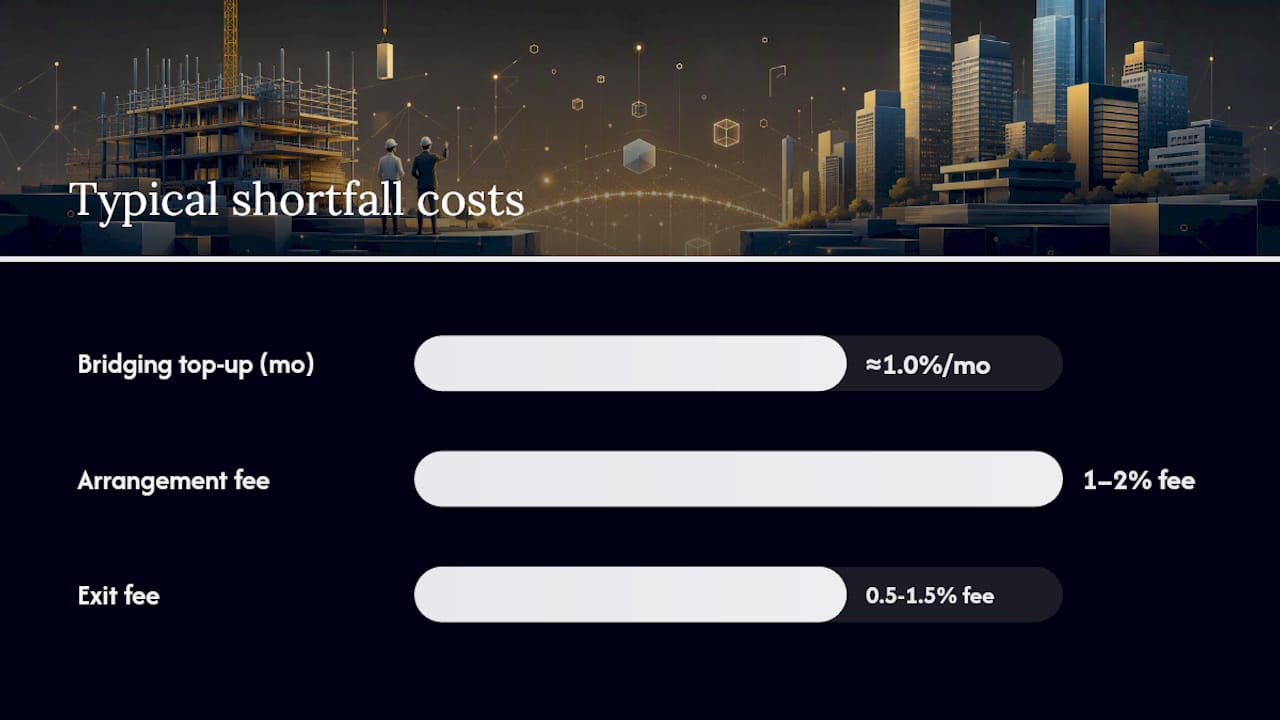
Table of Contents
- What is shortfall funding and when does it arise?
- What types of shortfall funding are available?
- What do lenders underwrite for shortfall funding?
- What do shortfall facilities typically cost?
- How do you arrange shortfall funding, and how long does it take?
- How can you prevent shortfalls, and what are the alternatives?
- What are the key risks and red flags to watch for?
- How a capital-concierge executes shortfall facilities
- Borrower checklist: what to prepare before applying
- When shortfall funding is the right call, and when it is not
- How James William & Co Capital can help with shortfall funding
- Sources
- FAQ
What is shortfall funding and when does it arise?
A funding gap rarely appears without warning. The triggers are usually structural, not accidental, and recognising them early is the difference between a manageable fix and a project crisis.
Common triggers include:
- Contractor cost overruns that breach the original cost plan and exhaust contingency
- Delayed contractor payment certifications, which create a timing mismatch: contractors need monthly payment before lenders reimburse after monitoring surveyor sign-off
- Acquisition timing gaps, particularly on auction purchases or short-exchange deals where senior finance cannot complete in time
- Valuation shortfalls, where a revised GDV or a lender’s haircut on comparable evidence reduces the available loan
- Sales slippage, where slower-than-projected unit sales erode the projected repayment schedule
- Unexpected professional costs: planning appeals, monitoring fees, or legal disputes that were not in the original budget
The timing dimension matters more than most developers expect. Senior lenders typically release debt in arrears against certified construction progress, so a developer can be technically solvent but cash-negative for weeks at a time. That gap, even a short one, can trigger lender arrears if it is not anticipated.
Pro Tip: Industry practitioners commonly recommend building a 10–15% contingency into development appraisals from day one. Lenders view a project with no contingency line as a red flag, not a sign of lean budgeting. If your contingency is already spent, shortfall funding is the next conversation.
What types of shortfall funding are available?
The right product depends on urgency, cost tolerance, security position, and exit route. There is no universal answer, but the choice usually narrows quickly once those four factors are clear.
-
Bridging loans suit situations where speed is the primary constraint: auction purchases, short-exchange completions, or immediate cash needs ahead of a refinance. Rates are typically modelled at 0.75–1.25% per month, and the exit is almost always a sale or refinance. Bridging works best when the exit is certain and near-term.
-
Mezzanine debt sits behind senior debt in the security stack and is priced accordingly, often at higher rates than bridging. It suits situations where the senior lender cannot or will not increase its facility, but the developer has sufficient equity cushion to support a subordinated charge. The trade-off is cost and covenant complexity.
-
Equity top-ups (sponsor equity or JV equity) avoid the interest burden entirely but dilute the developer’s return. A joint-venture partner or co-investor injects capital in exchange for a profit share. This is worth considering when the shortfall is large relative to project value and debt costs would be prohibitive.
-
Vendor top-ups involve the seller deferring part of the purchase price, effectively lending the buyer the shortfall. These require vendor cooperation and are more common in off-market or relationship-driven transactions.
-
Emergency top-up loans are short-duration, high-priority facilities arranged at speed when a project is at immediate risk of stalling. They are the most expensive option and should be treated as a last resort, not a planning tool. Formosity Funding outlines how these short-term facilities are typically structured and deployed.
For a detailed comparison of types of property finance and when each applies, the James William & Co Capital resource library covers the full product range.
What do lenders underwrite for shortfall funding?
Lenders assessing a shortfall facility are not starting from scratch. They are stress-testing a project that already has a senior facility in place, which means their scrutiny is often sharper, not lighter.
The core underwriting checklist:
- Security and ranking: what charge is available, and where does the shortfall lender sit in the stack? First-charge bridging is simpler; mezzanine requires an intercreditor deed with the senior lender.
- Exit plan: the single most important factor. Lenders want a credible, documented route to repayment — sale, refinance, or equity event — with realistic timing assumptions.
- Up-to-date valuation: a current RICS-compliant valuation of the site or completed units, with GDV evidence from recent sales comparables.
- Certified cost reports and QS sign-off: a quantity surveyor’s report showing the revised cost plan, remaining works, and contingency position. Lenders treat unsigned or outdated QS reports as a deal-stopper.
- Borrower track record and liquidity: evidence of completed comparable projects and proof that the sponsor has sufficient liquidity to cover unforeseen costs beyond the facility.
- Programme and draw schedule alignment: a month-by-month cashflow model that matches the contractor payment schedule to the proposed drawdown profile. Auditable, document-traceable assumptions are non-negotiable at credit committee.
- Contingency and stress testing: what happens if costs rise a further 5–10%? Lenders want to see this modelled, not assumed away.
Documents to prepare before approaching a lender: QS cost report, build contract and procurement route, programme and draw schedule, monitoring surveyor notes, GDV evidence and sales comparables, proof of sponsor liquidity, and full details of the existing senior facility.
What do shortfall facilities typically cost?
Cost varies significantly by product, security position, and urgency, but the following ranges reflect common market practice.
- Interest rates: bridging at 0.75–1.25% per month; mezzanine typically higher, often 1.25–2.0% per month or equivalent annual rates depending on structure
- Arrangement fees: 1–2% of the facility, payable on drawdown or deducted from the advance
- Monitoring fees: charged by the lender’s appointed monitoring surveyor, usually monthly
- Exit fees: 0.5–1.5% of the facility on repayment, more common on mezzanine than bridging
- LTV/LTC expectations: senior plus mezzanine stacks rarely exceed 75–80% of GDV; bridging shortfall facilities are typically sized to keep the blended stack within that range
- Term lengths: 3–18 months is the common range; emergency top-up loans can be shorter
Worked example (illustrative only): A developer has a £4m senior facility on a scheme with a revised cost plan of £4.35m. Monthly interest: £3,500. Total interest cost over six months: £21,000. Against a GDV of, say, £6m, that is a manageable cost — but it must be modelled into the appraisal from the moment the gap is identified, not after.
Mezzanine pricing changes the arithmetic materially. At 1.5% per month on the same £350,000, monthly interest rises to £5,250 and the six-month cost before fees exceeds £31,500. The current market context for property finance pricing is worth reviewing before fixing assumptions.
How do you arrange shortfall funding, and how long does it take?
Speed is usually the point. Here is a realistic sequence from first call to drawdown.
- Initial enquiry and diagnostic (24–72 hours): share the project summary, existing facility details, cost position, and proposed exit. A specialist will identify the most likely product and lender profile.
- Information pack submission (1–3 days): prepare and submit the full document set (QS report, programme, valuations, proof of funds).
- Lender selection and approach (2–5 working days): the structuring partner approaches suitable lenders simultaneously, not sequentially.
- Term sheet issued (3–7 working days from lender receipt of full pack): terms are negotiated and a heads of terms or term sheet is agreed.
- Valuation and monitoring surveyor instruction (1–2 weeks): lender-appointed professionals review the site and cost position.
- Legal and security documentation (2–4 weeks, deal-dependent): intercreditor deeds, charge registration, and facility agreements. Mezzanine deals take longer than bridging due to intercreditor complexity.
- Drawdown: once security is in place and conditions precedent are satisfied.
Total elapsed time from enquiry to drawdown: as little as three weeks for a straightforward bridging top-up; six to eight weeks for a mezzanine facility requiring intercreditor negotiation. Every delay in document preparation adds directly to that timeline. Arranging bridging finance efficiently depends almost entirely on how complete the information pack is at the point of submission.
Pro Tip: The fastest shortfall deals share one characteristic: the developer had the document pack ready before the gap became critical. Prepare the QS report, programme, and GDV evidence as soon as a potential shortfall is identified — not after a lender has been approached.
How can you prevent shortfalls, and what are the alternatives?
Prevention is cheaper than cure. The most reliable measures:
- Build a 10–15% contingency into the appraisal at the outset and treat it as a hard reserve, not a soft buffer
- Link contractor payments to certified progress milestones, not calendar dates
- Commission monthly monitoring surveyor reports throughout the build, not just at drawdown events
- Hold insurance and retentions against contractor default
- Pre-agree a JV equity top-up mechanism with a co-investor before the project starts, so the trigger and terms are already documented if needed
When prevention has not worked, the structural alternatives to shortfall funding are: restructuring the capital stack (bringing in additional senior debt if LTV allows), negotiating vendor deferred consideration, or agreeing a phased sales programme that releases cash earlier. Optimising the capital stack before a gap materialises is almost always less expensive than fixing it afterwards.
Pro Tip: A 10–15% contingency covers cost risk. It does not cover programme risk or market risk. If a project is running six months late, the contingency may be intact but the carrying cost and sales timing assumptions are broken. That is when shortfall funding becomes the only viable path — and why early diagnosis matters.
What are the key risks and red flags to watch for?
For borrowers and lenders alike, certain patterns signal that a shortfall is becoming unmanageable.
Red flags to act on immediately:
- No clear exit plan: if repayment depends on a single event (one buyer, one refinance) with no fallback, the facility is structurally fragile
- Weak or outdated cost evidence: a QS report more than three months old, or one that has not been updated since the overrun occurred, will not satisfy credit committee
- Unusually late certified progress: if contractor certifications are consistently behind programme, the draw schedule is unreliable and lenders will notice
- Single-point-of-failure contractors: a project dependent on one specialist subcontractor with no alternative procurement route carries outsized programme risk
- Aggressive sales timing assumptions: GDV evidence that relies on comparable sales from a different market cycle or location
- Mismatch between contractor payment cadence and lender draw schedule: this is the most common operational trigger for arrears, and it is almost always avoidable with proper cashflow modelling
If a covenant breach occurs or a lender exercises step-in rights, costs escalate quickly. Lender-appointed receivers or project monitors add fees and slow decisions. The remedial path is straightforward: stop, model the revised position honestly, identify the gap, and speak to a specialist before the situation is presented to the existing lender. Lenders respond better to a developer who arrives with a solution than one who arrives with a problem.
How a capital-concierge executes shortfall facilities
The capital-concierge model, as practised by James William & Co Capital, compresses the time between identifying a gap and securing a facility by running diagnostics, lender selection, and underwriting alignment in parallel rather than in sequence.

How it works in practice:
A developer on a 48-unit residential scheme identified a £600,000 cost overrun at month seven of a twelve-month build. The senior lender had no appetite to increase its facility. The developer needed funds within four weeks to avoid contractor payment default.
James William & Co Capital’s approach: rapid cost-plan review alongside the existing QS report, identification of three suitable mezzanine lenders from its panel, simultaneous submission of a structured information pack, and negotiation of an intercreditor deed with the senior lender in parallel with legal documentation. The facility was drawn in 26 days.
The outcome was not just speed. That saved approximately £9,000 on a £600,000 facility.
Why a specialist partner reduces time and cost:
- Lender panel access means simultaneous approaches, not sequential ones
- Pre-existing relationships with intercreditor solicitors reduce legal negotiation time
- Underwriting alignment before submission reduces the risk of a credit committee decline
- Fee transparency: James William & Co Capital discloses its fee structure and any lender-paid commission at the outset of any mandate
For further context on structured property finance and layered debt execution, the firm’s published guidance covers the mechanics in detail.
Borrower checklist: what to prepare before applying
Organising these items before approaching any lender or structuring partner cuts underwriting friction significantly and reduces time to term sheet.
- Up-to-date QS cost report (dated within three months, signed)
- Build contract and procurement route summary
- Programme and draw schedule (month-by-month, aligned to contractor payment dates)
- Monitoring surveyor notes from the most recent site visit
- GDV evidence: recent sales comparables, agent appraisals, or pre-sale agreements
- Proof of sponsor liquidity (bank statements, asset schedule)
- Full details of the existing senior facility: facility letter, current balance, covenant schedule, and any existing arrears or waivers
James William & Co Capital provides a development funding checklist that developers can use to audit their document position before making an enquiry. Requesting it takes one conversation.
When shortfall funding is the right call, and when it is not
The conventional view is that shortfall funding is a sign of poor planning. That is too simple.
Cost overruns on complex development projects are not exceptional. They are statistically normal. The question is not whether a gap might appear, but whether the developer has the tools to close it without derailing the project. A developer who has pre-modelled the shortfall scenario, has a document pack ready, and approaches a specialist early will almost always find a workable solution. One who waits until the contractor is threatening to walk off site has far fewer options and will pay for the delay in both cost and time.
What I see more often than poor planning is poor timing. Developers who identify the gap early but delay acting because they hope the problem will resolve itself. It rarely does. The cost of a six-week delay in arranging a shortfall facility is not just the additional interest. It is the contractor premium for remobilisation, the monitoring surveyor’s additional visits, and the reputational cost with the senior lender.
The capital-concierge approach exists precisely for this scenario: a single point of contact who can run diagnostics, model the options, and approach the right lenders simultaneously. That is not a luxury for large schemes. On a £2m project, the difference between a well-structured shortfall facility and a poorly timed one can be the difference between a profitable exit and a break-even.
How James William & Co Capital can help with shortfall funding
When a funding gap appears on a live project, the priority is a fast, accurate diagnosis and a lender approach that does not waste time on unsuitable options.
James William & Co Capital acts as a capital concierge for developers, investors and high-net-worth clients facing shortfall situations. The firm structures and arranges bridging top-ups, mezzanine facilities, and equity solutions across its panel of family offices, private credit funds and specialist lenders. An initial diagnostic call takes 30 minutes and covers the gap size, security position, exit plan, and likely product fit.
To start the process, contact the team via the specialist property finance page or request the development funding checklist directly. Fees and mandate terms are disclosed at the outset of every engagement.
Sources
- Funding Property Development: A UK Practitioner’s Guide | Domus
- Business Funding Options | Formosity Funding
This article provides general information about shortfall funding structures and is not financial or legal advice. Confirm current terms, rates, and eligibility with a qualified finance professional before proceeding.
This article is general information, not a substitute for advice from a qualified financial advisor. Consult a qualified financial professional about your own circumstances before acting on anything here.
FAQ
What is shortfall funding in property development?
Shortfall funding is bespoke gap finance arranged to cover a cost overrun or funding shortfall on a property project. It typically takes the form of a bridging loan, mezzanine debt, equity top-up, or emergency top-up loan.
How quickly can shortfall funding be arranged?
A straightforward bridging top-up can complete in as little as three weeks from enquiry to drawdown. Mezzanine facilities requiring intercreditor negotiation typically take six to eight weeks.
What do lenders look for when underwriting a shortfall facility?
The three priorities are a credible, documented exit plan; a current QS cost report; and a month-by-month cashflow model with auditable assumptions traceable to the build contract and programme.
How much does shortfall funding cost?
Mezzanine debt is priced higher. All figures are deal-specific and depend on security position, LTV, and term.
Can James William & Co Capital arrange shortfall funding for my project?
Yes. James William & Co Capital structures and arranges shortfall facilities across bridging, mezzanine, and equity products for UK developers, investors and high-net-worth clients, with simultaneous lender approaches and full fee disclosure from the first call.
Recommended
Related Topics
Speak to a specialist
Discuss your finance with James directly
Whole-of-market specialist finance — bridging, development, commercial and residential. No call centres, no obligation. James reviews every enquiry personally.
New to specialist finance? How unbiased broker advice works · Deals we have completed
Explore Related Finance